The Paradox of Purpose: Why "Doing Good" Has Become an Operating Discipline
November 24, 2025
8 min read
In the GCC's next chapter, purpose stops being a brand statement and starts deciding where capital, talent, and trust actually flow.
Key takeaways
Purpose creates value when it governs decisions, not when it decorates the annual report. The differentiator is whether it shapes capital allocation, hiring, and the trade-offs leaders would otherwise make on autopilot.
The performance link is now measurable rather than aspirational: purpose-aligned companies report materially higher revenue and profit, and purpose-driven family firms are outgrowing their peers.
The real risk is not the absence of purpose. It is purpose drift, the quiet gap between what an enterprise says it stands for and what its operating model actually rewards.
Embedding purpose is an architecture problem spanning strategy, operations, governance, and culture. It is solved with a decision discipline, not a communications campaign.
For most of the last two decades, purpose lived in the margins of the business. It was useful for the sustainability report, the recruitment brochure, and the founder's anniversary speech, yet rarely present when the consequential decisions were actually made. That separation is no longer affordable. Customers increasingly buy on values, the strongest talent screens for meaning before salary, and investors now price governance and societal contribution into the cost of capital. In the Gulf the shift is sharper still: national diversification agendas have made localization, economic contribution, and sustainability explicit expectations of any serious enterprise, not optional extras.
Yet most organizations have upgraded their language faster than their operating model. CECP's Giving in Numbers: 2025 Edition found that 87% of large companies now hold a formal purpose statement and more than 90% use it to guide business decisions. Holding one and running on one, however, are very different things.
Share
The real problem leaders underestimate: purpose drift
The danger for most enterprises is not that they lack a purpose. It is that purpose slowly detaches from how the business operates, a condition worth naming plainly: purpose drift.
Drift rarely announces itself. It shows up as strategy that invokes purpose in the offsite but ignores it at the investment committee. It shows up as processes tuned for this quarter's efficiency while broader stakeholder outcomes quietly erode, as employees who can recite the mission but cannot connect it to Tuesday's work, and as leaders who champion values externally while their decisions reward something else entirely. Each gap is small. Together they produce a credibility deficit, where the purpose stays visible on the wall while its influence disappears from the room.
This matters more, not less, for family enterprises. Their legitimacy has always rested on something larger than the P&L: reputation, continuity, and the trust of communities they have served across generations. PwC's 2025 Global Family Business Survey, covering 1,325 firms across 62 countries, found that safeguarding the business and preserving the family's legacy rank as the top two long-term goals for family leaders, and that the agile, purpose-driven firms in the sample are outgrowing their peers, with 31% reporting double-digit growth against 21% for the rest. For a family group, purpose drift is not a branding lapse. It is the erosion of the very asset that is supposed to compound across generations.
A better lens: purpose is a decision rule, not a message
The reframe is simple to state and demanding to live. Purpose is not something to be communicated; it is something to be applied. The useful question is not "what is our purpose?" but "where, this quarter, did our purpose change a choice we would otherwise have made?" If the honest answer is "nowhere," the enterprise has a statement, not a system.
The link to performance is no longer a matter of faith. CECP found that companies whose metrics are tied to their purpose reported 25% higher median revenue and 22% higher median pre-tax profit than those without, and that companies with a clearly defined purpose statement saw 58% more revenue growth and 63% higher return on invested capital. Designed correctly, purpose and performance stop being a trade-off and begin reinforcing one another.
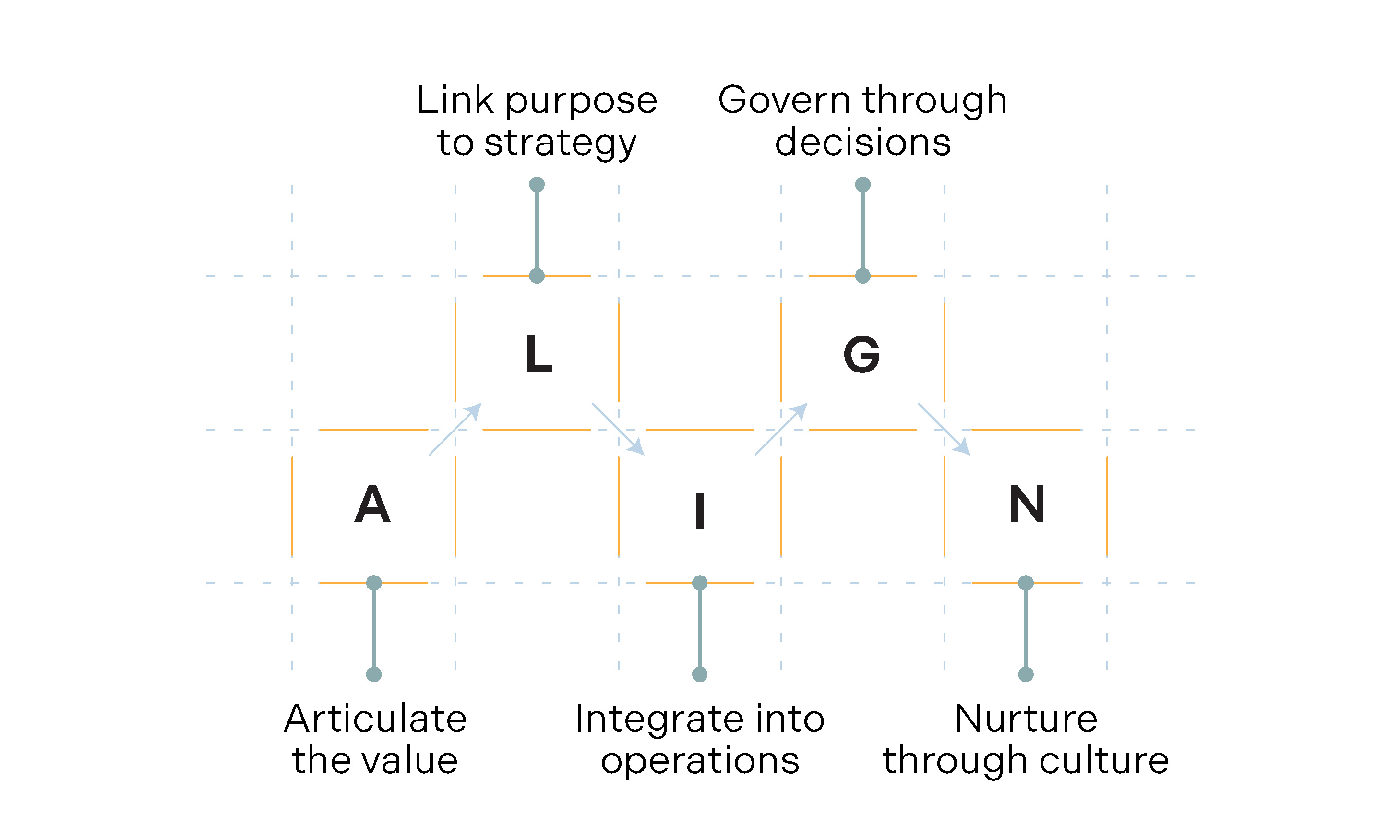
The ALIGN discipline
A practical way to close the drift is ALIGN, five moves that convert purpose from aspiration into an operating capability.
A, Articulate the value
Define, specifically, the outcomes the enterprise exists to create for customers, employees, communities, and shareholders. A vague aspiration such as "we better lives" guides nothing. A purpose precise enough to rule a decision in or out is the only kind that changes behavior.
L, Link purpose to strategy
Subject every major initiative to one test, namely how it advances the stated purpose, and back the answer with money. Alignment is proven in resource allocation, not in slide decks. A purpose that no budget line defends is decoration.
I, Integrate into operations
Embed purpose where work actually happens: procurement standards, product design, service-level choices, supplier terms. Purpose becomes real the moment it constrains an operational decision someone would rather make differently.
G, Govern through decisions
Require leadership forums to weigh material decisions through both a commercial and a purpose lens, and to log the trade-off when the two pull apart. Governance is what turns purpose from philosophy into a repeatable choice.
N, Nurture through culture
Reflect purpose in what gets recognized, promoted, and rewarded. Employees read incentives, not posters. Culture is where purpose either compounds or quietly dies
What good looks like
When purpose is governing rather than decorating, the shift is observable. Purpose statements give way to purpose systems. Isolated CSR initiatives give way to value created through the core business. Short-term optimization gives way to decisions defended on a longer horizon. And stakeholder management, the work of handling people, gives way to stakeholder trust, which is far cheaper to keep than to repair.
A simple diagnostic: if your purpose statement vanished overnight, which decisions next quarter would actually be made differently? The length of that list is your real purpose.
How to execute: five moves in the next 90 days
Run a purpose alignment review that maps where strategic priorities and capital actually conflict with the stated purpose, and treat the conflicts as the finding. Identify the handful of recurring decisions, such as investment, hiring, sourcing, and pricing exceptions, where purpose should change the outcome, and write the rule. Audit incentives to confirm that performance measures reinforce both commercial and purpose outcomes rather than silently trading one for the other. Translate purpose into role-level terms so a frontline manager can name what it changes in their week. Finally, track a small set of purpose-performance indicators across customers, employees, communities, and the P&L, so impact becomes visible rather than asserted.
Risks and trade-offs
The first risk is purpose-washing, communicating purpose without changing behavior; the mitigation is to tie purpose to logged decisions and measurable outcomes. The second is initiative overload, where purpose becomes yet another parallel program; the mitigation is to integrate it into existing processes rather than building new structures. The third is genuine short-term tension, since purpose-led choices may occasionally cost near-term margin; the mitigation is to evaluate those decisions on a long-term value horizon, which is where family enterprises hold a structural advantage. The fourth is cultural cynicism, which sets in fast when leadership behavior contradicts stated values, and the only mitigation is visible consistency between what leaders say and what they reward.
Leadership questions
Where does our purpose genuinely change a decision today, and where is it merely quoted?
Which of our strategic priorities can we defend as advancing our purpose, and which cannot?
Are our incentives reinforcing purpose, or quietly undermining it?
How would a frontline manager describe our purpose in operational terms?
If our purpose statement disappeared tomorrow, what would actually change?
The most successful enterprises of the next decade will not choose between purpose and performance. They will recognize that, designed well, the two are inseparable, and that for family businesses a purpose lived rather than displayed is the mechanism by which a legacy compounds instead of fading. Done properly, doing good stops being a cost. It becomes the discipline that earns the next generation's trust.
Share
References
Chief Executives for Corporate Purpose (CECP). Giving in Numbers: 2025 Edition and Corporate Purpose: Driving Business Value, 2025 Edition. 87% of companies hold a corporate purpose statement and more than 90% use it to guide business decisions; companies with purpose-aligned metrics report 25% higher median revenue and 22% higher median pre-tax profit; companies with a clearly defined purpose saw 58% more revenue growth and 63% higher return on invested capital in 2023.
PwC. 2025 Global Family Business Survey (1,325 family businesses across 62 countries). Purpose-driven, agile family firms reported double-digit growth at a higher rate than peers (31% versus 21%); safeguarding the business and preserving the family's legacy ranked as the top long-term goals.


.jpg)
.svg)


.jpg)
.jpg)
.jpg)


