Capital Changed. Governance Didn’t.

The source of capital has shifted from banks to private and non-bank sources, faster than the governance of it has caught up.

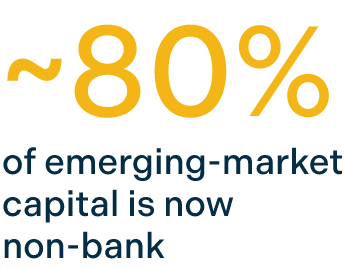
Roughly 80% of the capital now flowing to emerging markets comes from non-banks, not banks (IMF, 2026). The money is no longer mostly the bank’s, yet few balance sheets are governed as if that were true.

THE SIGNAL

A decade ago, capital in the region meant a bank. Today it means a fund, a family office, a sovereign-linked vehicle or a private-credit manager, and the source of capital has changed faster than the way institutions govern it. The UAE built this architecture deliberately, and Dubai and Abu Dhabi’s financial centres now host hundreds of asset managers alongside a fast-growing private-credit industry. The depth is real, and it is an achievement. Yet non-bank capital is more lightly regulated, less visible and quicker to move, so the shift that is rightly celebrated as access is also, quietly, a new kind of risk

WHY IT MATTERS HERE

The danger is not the cost of capital but the behaviour of capital, which is patient until it is not. For a government or sovereign-linked entity, financing that once came from relationship banks now comes partly from global funds that can reprice or withdraw on a shock originating thousands of miles away, and the gap shows up not in the term sheet but in a refinancing window two years out. For a family enterprise, fund and private-credit money arrives faster and with fewer questions than a bank loan ever did, until a downturn arrives and the new lender, with no decades-long relationship to protect, simply enforces the terms a house bank would have quietly renegotiated. For an African sovereign the shift is sharpest of all, because private creditors now hold a far larger share of external debt than a decade ago, at higher rates and shorter maturities, so that a global risk-off moment lands as a debt-service spike rather than a polite conversation. It is the same capital in three exposures: cheaper and faster to raise, and harder to hold when the weather turns.

THE SYNARCHY READ

The conventional story is that deeper capital markets are an unalloyed win: more funds, more hubs, more private credit, more sovereign capital, all of it evidence of arrival. That story is half true, and therefore dangerous, because what has actually happened is subtler. The source of capital has changed, and the governance of capital has not kept pace with it.

Every framework is context wearing a disguise.

That was never the real choice. There is a serious version of the opposing case, and it deserves stating plainly: resilience is inefficiency by another name, the excess inventory and duplicated suppliers and capital tied up in slack that a leaner rival would return to its shareholders. In a stable, globalising world that view was largely correct, for single-sourcing and just-in-time delivery were the rational design and redundancy really was waste. It stops holding the moment disruption becomes permanent, because the value of being able to keep operating through a shock then exceeds the cost of carrying the slack that makes it possible. The evidence now runs the other way. The IMF finds that diversification, one of the core mechanisms of resilience, is associated with sharp growth accelerations and lower volatility, and judges in its 2026 outlook that economies with diversified bases hold more resilient growth than concentrated ones. That is why resilience is no longer the tax on growth but increasingly the mechanism of it.

Engineers have understood the principle for a long time. A bridge built with no tolerance, carrying no more than the load already upon it, is not efficient but precarious, a single heavy truck away from failure; its margin is not waste but the design. A supply chain, a balance sheet or an operating model built without tolerance fails in exactly the same way, and for the same reason. The region’s own posture makes the timing plain, because disruption no longer ends. When shocks were episodic, an institution could run lean and rebuild afterwards; when they are continuous, with AI churning skills and business models and with supply chains and capital repricing on distant events, there is no afterwards in which to rebuild. Resilience bolted on always arrives late, because the institutional response moves slower than the reality it answers to. The only kind that holds is designed into the operating system from the start, diversified by default and able to sense a shock early and bend without breaking.

The most resilient systems are built that way deliberately. The Netherlands treats the management of water as foundational infrastructure rather than as contingency, and Singapore approaches food security through the careful diversification of its supply; neither was improvised after a disaster, and in both resilience was authored into the system as a condition of operating at all. The region has the same authoring advantage. The UAE did not diversify and then grow; its non-oil economy passed a trillion dollars in trade as it diversified, the two rising together. The instruction for every institution is the same: stop treating resilience as the price of ambition, author it into the model and fit it to your own exposures, and it becomes what lets the ambition survive the decade.

Access to capital isn’t the achievement. Governing its reversal is.

THE EVIDENCE

of capital flowing

80%

The source has flipped.

Roughly 80% of capital flowing to emerging markets now comes from non-banks, with cumulative portfolio flows near $4 trillion, an eightfold rise since the global financial crisis. (IMF, Global Financial Stability Report, 2026)

half

of the world’s financial assets

And it is lightly governed.

Non-banks hold around half of the world’s financial assets, mostly under lighter regulation and limited disclosure; the Financial Stability Board flagged the specific vulnerabilities of private credit in May 2026. (IMF, 2025; FSB, 2026)

ADGM’s assets rose

36%

The UAE built the architecture deliberately.

ADGM’s assets under management rose 36% in 2025, and DIFC ended the year with more than 500 wealth and asset-management firms. (ADGM; DIFC, 2025–26)

nearly doubled

external debt

For African sovereigns the shift is sharpest.

The private-creditor share of least-developed-country external debt nearly doubled, from 14% to 25%, between 2010 and 2023, at higher rates and shorter maturities. (UNCTAD)

THREE MOVES

01

Map your capital by behaviour, not just cost.
List every funding source and mark how each behaves under stress: who can reprice, who can withdraw, how fast, on what trigger. A balance sheet sorted by cost hides the risk; one sorted by exit behaviour reveals it.

02

Stress-test the reversal, not just the rate.
Model the funding window that matters, the refinancing or redemption point two years out, against a global risk-off shock rather than today’s calm. The question is not “can we service this?” but “what happens if this capital is gone when we need to roll it?”

03

Author the governance to match the source.
Build a financing-resilience framework fitted to non-bank capital: covenant discipline, diversified maturities, committed liquidity lines, and a named owner for funding risk. Don’t run a non-bank capital base on a bank-era risk model.

THE EDGE

The capital will keep flowing, and the centres will keep growing. But in the next downturn, access to capital will not be the achievement; governing its reversal will be.

Sources: International Monetary Fund, Global Financial Stability Report (2026) and Oct 2025; Financial Stability Board, Report on Vulnerabilities in Private Credit (May 2026); ADGM and DIFC annual results (2025–26); UN Trade and Development (UNCTAD).

The Synarchy Edge is Synarchy Consulting’s monthly thought-leadership series on the structural shifts — in strategy, capital, technology, talent and governance — reshaping how institutions across the GCC and Africa compete and endure.

Thank you! Your submission has been received!
Oops! Something went wrong while submitting the form.

Do you want to embark on an inspiring journey that drives growth and impact? Join us to create excellence together