The Wrong Scoreboard

Organisations have spent a decade measuring what they build from data, whether products, pipelines, platforms or models. It is the wrong scoreboard. Value was never in the artefact; it is in the decision the artefact changes.

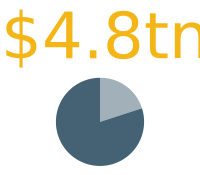
AI market by 2033, yet only a third of developing economies have a strategy to capture it

The AI market is projected to reach $4.8 trillion by 2033, yet its benefits stay “highly concentrated,” and only about a third of developing economies even have a national AI strategy to convert that potential into value (UNCTAD, 2025). The potential is everywhere; the capacity to capture it is not.

THE SIGNAL

Walk into almost any large organisation and the data machinery is impressive: platforms, dashboards, governance frameworks, analytics teams and a row of AI pilots. Walk into the same organisation and ask what measurable enterprise value all of it created, and the room goes quiet. The investment keeps rising; the value rarely keeps pace. This is not a tooling problem or a talent problem, since both are better than they have ever been. It is a measurement problem. Every era keeps a scoreboard that measures motion in place of progress: the dot-com years counted page views, software teams once counted lines of code, and the social platforms counted followers, each of them an activity mistaken for an outcome. Counting the data products an organisation has built is the same error wearing the clothes of a new decade, and AI is about to make it impossible to ignore, because it removes every excuse that used to hide it.

WHY IT MATTERS HERE

For governments, the stakes are concrete, since AI could add value equivalent to roughly 6% of each economic sector’s GDP across the GCC, but only for institutions able to turn capability into delivered outcomes rather than those that simply stand up platforms. For large operators, the row of AI pilots is the tell, because most never reach production, not because the models fail but because nothing downstream changes: no decision moves and no process is rebuilt. For family enterprises weighing their first serious data investment, the warning is sharper still, because it is entirely possible to buy the whole stack and capture none of the value, the value having never been in the stack. And across the region the pattern repeats at national scale, where the difference between economies that gain from AI and those that do not is not who has the technology but who is ready to act on it. The common thread is that data, analytics and AI are inputs, and on their own they are cost; they become value only when they change what an institution decides and does.

THE SYNARCHY READ

For a decade the scoreboard has measured outputs. Data products shipped. Pipelines built. Platforms stood up. Models deployed. Governance maturity climbed. Every one of those is real work, and every one of them is a measure of capability, the capacity to do something with data. None of them is value.

Every framework is context wearing a disguise.

Most institutions have spent a decade mastering the first and assuming the second would follow, and it does not follow on its own. The reason is structural rather than a matter of effort: value is not produced by the artefact but by the decision the artefact is meant to change, the moment someone, or something, does something different because of what the data showed. Everything before that decision is cost, and value appears only in the change it produces and the action that follows, which is precisely the thing no one was scoring.

AI sharpens the point to its finest edge. It can now run most of the chain itself, from perceiving and reasoning to planning and even acting, which strips away the work that used to look like value. When the machine can build the model and read the result, the only stretch that still decides who wins is the leap from decision to action: the adoption, the trust, the willingness to do something different. That leap is human, and it is where most institutions quietly stall.

There is a fair objection to all this, that you cannot draw value from data you have never organised, so the foundation must surely come first. And so it must, once: the foundation is a genuine prerequisite while it is still missing. The error lies in letting the prerequisite become the destination, in building and measuring and rewarding the foundation long after it is laid, while the decision it was meant to inform carries on exactly as before. This is strategic authorship applied to the value chain: not buying a vendor’s catalogue of “data products” and reverse-justifying the value, but authoring the chain backward from an outcome the institution actually cares about, naming the result, the action and the decision first, and only then the data that moves them. The instruction is the same for every institution: stop scoring the build, and score the decision it changes.

The data product was never the goal. The decision it changes is.

THE EVIDENCE

AI market is projected to reach

$4.8 trillion

The prize is vast, and concentrated.

The AI market is projected to reach $4.8 trillion by 2033, but its benefits remain “highly concentrated,” with diffusion outpacing the institutions meant to absorb it. (UNCTAD, Technology and Innovation Report 2025)

40%

global employment is exposed to AI

Exposure was never the outcome.

Almost 40% of global employment is exposed to AI, about 60% in advanced economies, yet the IMF built an AI Preparedness Index precisely because readiness to act, not exposure, decides who gains. (IMF, 2024)

a third of developing economies have a national

AI strategy

Capability is common; conversion is rare.

Only about a third of developing economies have a national AI strategy to convert capability into value, against two-thirds of developed economies. (UNCTAD, 2025)

6% of GDP

worth value can be added by AI

The region is authoring readiness.

The UAE and Saudi Arabia lead MENA on government AI readiness, and AI could add value worth roughly 6% of sector GDP across the GCC, with the African Union authoring a continental strategy. (Oxford Insights, 2024–25; GCC study)

THREE MOVES

01

Start at the outcome and back-track to data.
Name the enterprise outcome first, whether revenue, cost, risk or service, then ask which decision and action move it, and only then which data feeds that decision. Score the work by the decision it changes, not the product it ships. A backlog sorted by what gets built hides the value; one sorted by what gets decided reveals it.

02

Engineer the decision-to-action leap.
Treat adoption, trust and willingness as the real deliverable, because the best model no one acts on is worth nothing. Build the human side of the chain, the incentives, the training and the authority to change what you do, as deliberately as the technical side. The bottleneck is rarely the model; it is the leap to action.

03

Author your own value chain; let AI run it, not define it.
Map the chain to your own outcomes and constraints, then put AI to work across it, from perceiving to acting, where it earns its place. Do not import a vendor’s product taxonomy and reverse-justify the value; author the chain you need and let the technology serve it.

THE EDGE

The data will keep accumulating and the models will keep improving. But the advantage will not go to whoever holds the most data; it will go to whoever closes the gap to action first, before the category settles around someone else’s rules.

Sources: UN Trade and Development (UNCTAD), Technology and Innovation Report 2025; International Monetary Fund, Gen-AI: Artificial Intelligence and the Future of Work (2024) and The Global Impact of AI: Mind the Gap (2025); Oxford Insights, Government AI Readiness Index (2024–25); African Union, Continental AI Strategy. Value-chain framing draws on Info-Tech Research Group.

The Synarchy Edge is Synarchy Consulting’s monthly thought-leadership series on the structural shifts — in strategy, capital, technology, talent and governance — reshaping how institutions across the GCC and Africa compete and endure.

Thank you! Your submission has been received!
Oops! Something went wrong while submitting the form.

Do you want to embark on an inspiring journey that drives growth and impact? Join us to create excellence together