REPORT NOVEMBER 2026

Young Africans and the AI Landscape

Understanding Access, Adoption and the Pathways to Work and Income

AI is already part of how African economies work, and young Africans are using it. Whether this leads to better livelihoods depends on the conditions that shape how AI is accessed, adopted and used.

Also available: Research brief, Reach Is Not Participation: Young women and AI in Africa (PDF · 7 pages)

Illustration from the report cover: a woman in a headwrap in profile against blocks of orange, yellow and green.

AI is already part of young Africans’ working lives. Developers use it to work faster, creative entrepreneurs to compare prices, and farmers receive AI-enabled advice through mobile services. Others have not used AI themselves. Yet greater use does not necessarily mean better or more reliable income.

Developed by Synarchy Consulting in partnership with The Mastercard Foundation, this report examines how AI can support dignified, fulfilling work. It assesses 54 African countries, documents 69 AI initiatives, reviews ten national AI strategies, and draws on 40 focus groups with 310 young people, including 217 young women, across ten countries, alongside 100 interviews. The analysis follows five practical questions: access, cost, language, trust, and earnings.

The findings show why adoption alone is an incomplete measure of progress. Economic gains depend on how work is paid, how services are delivered and priced, whether local languages are supported, and whether AI advice and decisions can be checked and challenged. For young women, phone ownership, participation costs, training time, and control over payments intersect. Only two of the 69 documented initiatives report directly on earnings, highlighting the need to measure livelihoods alongside adoption.

In partnership with Mastercard Foundation

The question

What has to be true for AI use to translate into better work and earnings for young Africans, especially young women?

This report follows the path from AI use to economic benefit, asking whether gains from AI-assisted work translate into income that young people receive, and where that connection breaks.

It assesses AI against the standard of dignified and fulfilling work, with reliable income at its centre alongside working conditions and the quality of work. At its core are young people’s own accounts: in focus groups across ten countries, they described how AI enters their working lives and what stands between its use and their income.

The evidence behind this report

54countries assessed
69documented AI initiatives
40focus groups
310young people
217young women
100interviews
10national AI strategies

Five practical questions trace the path from access to economic benefit:

AccessCan young people access and use AI?
CostCan they afford to keep using it?
LanguageDoes it work in their language and context?
TrustCan they trust it, check it and challenge decisions that affect them?
EarningsDoes it improve their economic position?

This fifth question gives the first four their economic significance. Better access, lower costs, more relevant language and greater trust can make AI easier to use, but they do not by themselves improve a young person’s livelihood.

Prologue

Achieng, Thandi, Harriet and Nadège each reflect one of the four starting points used to recruit young people for the fieldwork.1 Their stories show how AI enters their working lives, the choices they make around it and what each young woman is working towards.

Illustration of Achieng working on a laptop.

Already earning with AI

Achieng

Front-end developer, Nairobi

I’m no longer stuck figuring out syntax or stuck 10 hours debugging something. Now I’m more focused on making the product more human, more user friendly, making the experience smoother.

Achieng is 26. She builds websites for a startup in Nairobi and takes up design work on the side. During a typical working day, she uses several AI tools to research, test designs, debug code and prepare material for clients. She pays for most of them herself. After showing her employer what the tools help her deliver, she is now negotiating better pay. In time, she hopes to build a design business of her own.

She works faster and is negotiating better pay

Illustration of Thandi with a parcel on her desk.

Running a business by phone

Thandi

Owner of a home-based creative business, Cape Town

If I could afford it [ChatGPT], I would definitely invest in the premium version because it does aid me on a daily basis.

Thandi makes and sells her products from home through Facebook groups, WhatsApp and Instagram, and she uses a free AI tool every day to compare prices when she buys materials. Her income moves with her sales, which vary from week to week. When asked what would make the biggest difference to her business, she did not name a tool or a course; she named a retailer willing to stock what she makes, her “big break.”

AI helps her sell, but buyers set her prices

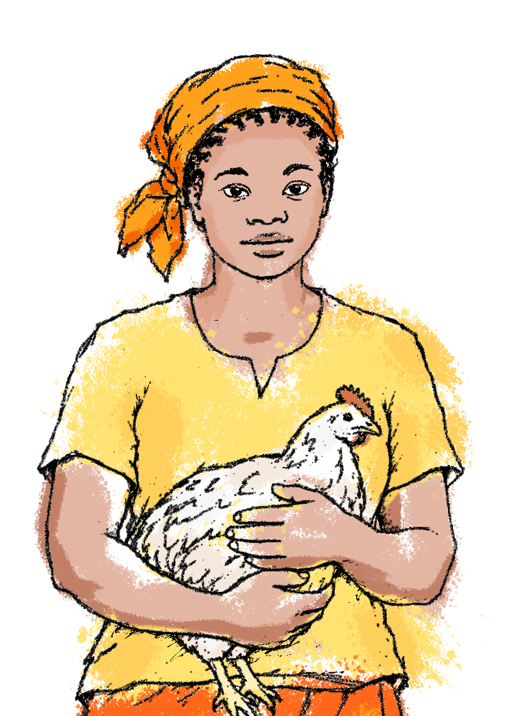
Illustration of Harriet holding a hen.

Farming with the phone as adviser

Harriet

Crop and poultry farmer, Uganda

I want to have a feed house… making my own concentrate… still have the farm, but then a much bigger one, seated on like 30 acres of land and still close to Kampala.

Harriet grows crops and keeps poultry, and her phone is one of her main sources of advice. She looks up treatments, feed and prices, then acts on what she finds, with her own money at stake. Once, a remedy she found online for a sick hen did not work, and she lost the bird. Even so, her phone is still the first place she looks for information. She wants more land and, one day, a feed house where she can make her own concentrate.

Advice raises income only when she can afford to act on it and sell

Illustration of Nadège standing in an apron.

Working mostly offline

Nadège

Laundry and domestic worker, Cotonou, Benin

Some people ask me to do their laundry, and once it’s done, they give me 1,000 or 1,500 francs.

Nadège is 20 and lives with her sister. She earns small sums washing clothes and cleaning for other households, and she is not always paid for work she has finished. She saved for a basic phone of her own, which she uses for calls and mobile money, and she uses her sister’s smartphone when it is available. She has heard about AI through her sister, who uses it to ask questions, but she has not used it herself. She is saving for a smartphone so that she can use digital tools on her own, and she hopes to run a business selling clothes and shoes.

Her first need is payment for work already done

AI can change the work before it changes the living

Back in the days I would have a project to design a website and it would take me a whole month but nowadays as clients know that there is AI, they give you a job but tell you to give them their website in two days because they are sure you can build and finish a website in two days.”

Keza, software developer, Rwanda
Illustration from the report: a young woman working at a laptop, holding a page.

AI can change how a task is done, but whether that improves a young person’s livelihood depends on whether she is paid for the value it creates. Three signs matter: her income becomes more reliable, her pay reflects the value or output she creates, and she retains control over what she earns.

Key findings

1

AI is already part of young Africans’ working lives.

Young people use AI through services they rely on, such as farm advice, payments and health care, and through tools they choose for their jobs and businesses. There is still little evidence on how this use affects their earnings.

2

Who gains from AI’s productivity depends on how work is paid.

Most young professionals interviewed said AI helps them finish work faster. Their pay has mostly stayed the same, as clients and employers have raised what they expect for the same price.

Earnings
3

The delivery channel sets how far an AI service reaches.

Services offered by text message, by voice or through health workers and extension agents reach young people whatever phone they have. When a provider chooses a channel, it is choosing who the service will serve.

Access
4

Pricing in US dollars limits regular use.

Many AI tools are priced in US dollars and paid for by international card. Young people with irregular incomes who pay through mobile money can use these tools now and then, but find it hard to keep using them. Prices in local currency, payment by mobile money and small-unit plans would let more of them use AI as part of their regular work.

Cost
5

Language resources set where AI services can be built for local users.

African-language datasets and technical resources are concentrated in a small number of countries. Open language data in more countries would widen where this is possible.

Language
6

Young people check AI advice before they act and need ways to question AI decisions made about them.

All ten national AI strategies reviewed refer to fairness, but few specify how a person can challenge an AI-supported decision.

Trust
7

Young women’s opportunities with AI depend on several conditions at once.

A phone of her own, time for training, the cost of taking part and control over the payments she receives tend to come together.

8

Turning AI use into better earnings needs several institutions acting together.

Governments set the enabling environment. Payment providers run the systems through which young people pay and get paid. Employers and clients set how work is rewarded. Training providers, funders and community organizations help young people take part. Each holds part of what is needed, so progress depends on how well they work together.

AI is already at work in African economies

AI reaches young Africans in different ways: through services they rely on, through tools they choose to use directly, and through the work of building and maintaining AI systems.

Organizations most often use AI to make an existing service faster, cheaper or more accurate. Building an entirely new service around AI is less common. As a result, many young people meet AI through the outcome of a service, such as a credit decision or a diagnosis, without using an AI tool themselves.

I can use AI to capture, then check the kind of disease. Just type what I’m facing, then the AI tries to advise me on what I might be doing.”

Lerato, poultry farmer, Limpopo, South Africa
Illustration from the report: a young woman tending a hen.

Three ways AI reaches young people

Through services run by organizationsA payment is cleared or held; a patient is referred after screening.
Through an intermediary or someone else’s deviceTuberculosis screening carried out by a health worker.
Through tools they choose to use directlyChatGPT and other general AI tools, often learned through friends, YouTube, TikTok and WhatsApp groups.

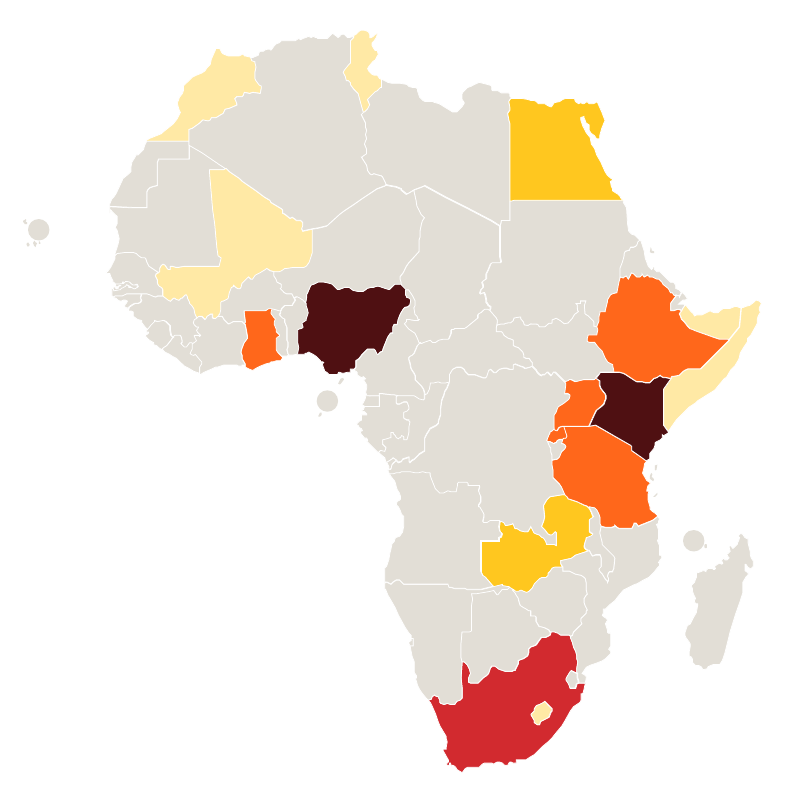
Documented AI initiatives often name Kenya, Nigeria and South Africa

Map of Africa shaded by the number of documented AI initiatives naming each country. Kenya and Nigeria are darkest, followed by South Africa.

Initiatives naming each country

Kenya23Nigeria19South Africa12Rwanda9Ghana8Ethiopia6Tanzania5Uganda5Egypt4Zambia2Somalia1Mali1Morocco1Lesotho1Tunisia1
None12 to 45 to 910 to 1415 or more

Some initiatives operate across several countries or regionally. Countries are counted where the source states that the initiative operates. Source: documented AI initiatives, this study (Annex A). The boundaries, names and designations shown on maps do not imply any position regarding the legal status of any country or territory, or endorsement or acceptance of any boundary.

A blank country does not mean that no AI is in use; it means that no initiative in the documented record names that country. The figure counts only the countries named in the underlying sources.

How documented AI initiatives in each sector are designed to help young people

SectorInitiativesEarnhelp increase incomeLearnbuild skills or knowledgeOwnbuild assets, credit or a businessProtectreduce risk to health, income or rights
Agriculture1312None58
Finance85None53
Trade and informal work52None13
Data work and AI services75211
Language AI989NoneNone
Education3None3NoneNone
Health10NoneNoneNone10
Public services4None1None3
Transport and logistics64None12
Energy44NoneNoneNone
All sectors6940151330

An initiative may serve more than one purpose, so rows can sum to more than the number of initiatives. Earn marks services designed to help increase income; it does not mean that earnings are reported. Source: Annex A.

About one in sixof the 69 documented AI initiatives reports an economic measure. Only two report directly on earnings: partial profit gains for wheat farmers in Ethiopia2 and the pay of data annotators at Sama.
72 per centof the USD 4.1 billion invested in African technology companies in 2025 went to Kenya, South Africa, Egypt and Nigeria.3

Young Africans build AI, and the terms of that work vary. Some build AI products and models. Lelapa AI develops speech and text tools for South African languages, Sunbird AI has released open models covering 31 Ugandan languages, the Masakhane research community builds datasets and benchmarks for more than 38 African languages, and InstaDeep, founded in Tunisia, develops AI for industry and biotechnology. Others are paid to prepare the data that AI systems learn from. In Kenya, Sama employs young people to label the data used to train AI systems, and an independent assessment found that the work met the statutory minimum-wage threshold but not the living-wage threshold.4

AI risks deepening divides that already exist, between countries, within them and for young women

The barriers to turning AI into higher incomes often lie in the conditions around its use: connectivity and power, the cost of tools and how they are paid for, language, and whether advice can be checked. Improving the technology alone does not remove these barriers.

“Some of the opportunities are advertised online, but because of the issues of internet connection in our communities, then I am not able to see them.”Palesa, looking for work, South Africa
Illustration from the report: a young woman looking at her phone.

These inequalities are well documented. In 2024, about 38 per cent of people in Africa used the internet: 57 per cent in urban areas against 23 per cent in rural areas, and 31 per cent of women against 43 per cent of men.5

In Sub-Saharan Africa, women are 29 per cent less likely than men to use mobile internet, and the cost of a handset and gaps in literacy and digital skills are among the main barriers.6

Each is necessary, and none is sufficient alone. Better access, lower costs, more relevant language and greater trust can make AI easier to use, but they do not by themselves improve a young person’s livelihood.

Access

Can young people access and use AI?

About 235 million of Africa’s roughly 545 million young people

The same assessment gives a modelled estimate for the population aged 15 to 35 in each country. On this index-weighted measure, current digital conditions could support AI-enabled services for the equivalent of about 235 million young Africans, including about 94 million young women. The estimate does not count AI users or measure access or use.7

Young people aged 15 to 358About 545 million
Modelled potential AI reachAbout 235 million
Including young women, modelledAbout 94 million

A modelled estimate, not a count of users. An index-weighted population equivalent, not a count of individuals.

Services delivered by SMS, voice or through a frontline worker can reach people who are otherwise constrained by device, budget or signal and cannot use an app.

Cost

Can they afford to keep using it?

Tools priced in dollars are hard to sustain on informal earnings

Participants described data bundles running out before a task was finished, subscriptions priced in US dollars and free tiers ending partway through the work. Trainers described difficulty sustaining a subscription of around USD 20 per month for many informal earners.

7countries host a global cloud provider or five or more data centres
16countries have two to four data centres
31countries have one data centre or none9
“Right now you have to pay for everything. There are a lot of subscriptions. It’s so hard to keep up with the upcoming trends.”Achieng, front-end developer, Nairobi
Language

Does it work in their language and context?

Between 1,000 and 2,000 African languages by most estimates

Only a small share are well represented in the data major AI systems learn from.10 Farmers spoke about working in Luganda, Ateso, Lugbara, Kinyarwanda, Kiswahili and Kikamba. The tools they encountered often answered first in English.

“When you search for information on the internet, it is presented in a language that not everyone can understand.”Uwimana, a seed multiplier in Rwanda
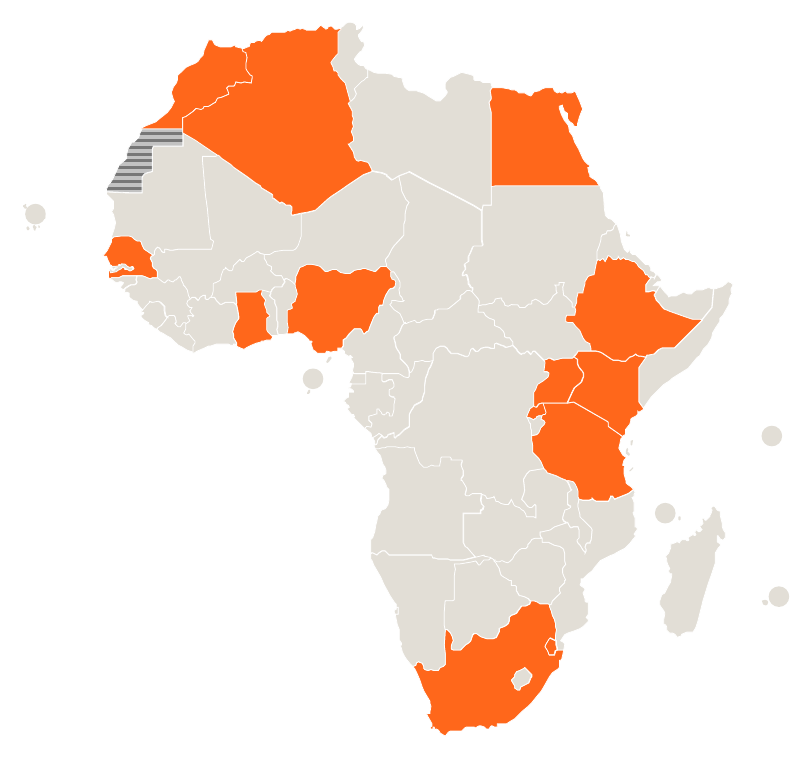
Map of Africa with 13 countries shaded as having stronger language resources.
Stronger language resourcesPartial or emerging language resourcesThe shading is an assessment classification, not a count of all language resources.
Trust

Can they trust it, check it and challenge decisions that affect them?

Young people act on advice they can check, and use services they can question

Participants were more willing to use advice when they could check it against another source, and more cautious when they could not. In the Nigerian tuberculosis screening program, software reading chest X-rays did not make the final diagnosis. People flagged by the system were referred for laboratory testing. The AI helped identify who should be tested further, and the laboratory confirmed the diagnosis.

23 of 54 countrieshad published a national AI strategy or policy by April 2026. All ten strategies reviewed refer to fairness; few set out how a decision can be challenged.

Where access to AI and opportunities to earn income from its use remain unequal, the benefits are likely to favour those already advantaged, potentially reinforcing existing inequalities. This is a pattern across the evidence; it has not been tested directly as a cause.

Data centres. Source: 54-country AI Landscape assessment, drawing on Cloudscene (2026), DataCenterMap (2026) and Isiadinso and Simmonds (2025). Language resources. Source: 54-country AI Landscape assessment, from Masakhane (n.d.) and Siminyu et al. (2023). The boundaries, names and designations shown on maps do not imply any position regarding the legal status of any country or territory, or endorsement or acceptance of any boundary.

Young women face several of these conditions at once

For many young women, care responsibilities, mobility, safety, access to a phone and control over money can overlap. Any one of these may be manageable on its own. Together, they can make it harder to use a service consistently or turn that use into income, even when the technology works and a buyer exists.

For young women, the stronger response is to address several conditions together, close to where they live and on terms that allow them to retain control over how they participate and what they earn.

If you make training free but it’s not safe to travel there, women won’t come. If you make it safe but her husband won’t let her go, she won’t come. If her husband lets her go but she has no one to look after her children, she won’t come.”

A key informant in Kenya
A phone of her ownA borrowed or shared device may enable occasional use, but it can limit the time and privacy available to experiment, learn and return to a tool regularly.
Time for trainingA day at a training venue may mean a day without earnings and, for women with children, the need to arrange care.
The cost of taking partInformants described cash allowances close to a day’s earnings as one way programs had made participation more feasible.
Control over the payments she receivesWhere payment reaches an account controlled by someone else, earning income does not necessarily mean controlling it.

Institutions can strengthen the link from AI use to income

Each of the conditions that stand between AI use and income can be strengthened, and the evidence in this report shows where that work has begun. In the authors’ reading of the evidence, every question involves at least three groups, and every group has a role in addressing at least three questions.

Access

Can young people access and use AI?

What the research foundPower, networks and devices differ widely between and within countries. Young women are less likely than young men to use mobile internet.
What needs strengtheningTwo things need strengthening: the underlying digital conditions themselves, and the channels that can reach people while those conditions remain uneven.
Where it has startedSMS weather forecasts reach farmers on basic phones. Health workers bring AI-assisted chest X-ray screening to communities.
Cost

Can they afford to keep using it?

What the research foundTools are priced in US dollars and billed to cards. Free tiers end partway through a task. Local builders face high compute costs.
What needs strengtheningWhat needs strengthening, then, is how it can be paid for, the cost of taking part in training and the cost of building services close to their users.
Where it has startedEmployers or public programs pay for the tool a young person uses.
Language

Does it work in their language and context?

What the research foundMany tools answer first in English. Resources for African languages sit in a small number of countries.
What needs strengtheningLanguage data for the languages people actually work in, and evidence that a service performs well in that language.
Where it has startedA public-health chatbot in Rwanda built on Kinyarwanda language data.
Trust

Can they trust it, check it and challenge decisions that affect them?

What the research foundYoung people act on advice they can check. The ten strategies reviewed name fairness, and few set out how to challenge a decision.
What needs strengtheningA way to check the advice a service provides, and a route to challenge decisions that affect income or access to a service.
Where it has startedLaboratory confirmation after AI-assisted tuberculosis screening in Nigeria. Kenya’s complaints and redress mechanism (proposed).
Earnings

Does it improve their economic position?

What the research foundYoung professionals reported faster work with little change in pay so far. Few of the documented AI initiatives report an economic result, very few report directly on earnings and none of those reviewed reports results by gender.
What needs strengtheningThe earning arrangement itself: who pays for the gain, on what terms and into whose account.
Where it has startedA training program in Egypt counts success at a participant’s first payment for work.

Which institutions can strengthen the link from AI use to income, and where they can begin

Governments and regional bodiesPublic procurement and programs that pay for work
Infrastructure and financial service providersPayments into accounts young women control
Platforms, innovators and employersPay and orders that reflect higher output; entry-level roles kept open
Universities, training providers and research communitiesTraining tied to a named employer, buyer or client
Development finance and philanthropyFinance routes to paid work; measure earnings over time
Community and intermediary organizationsLinks to buyers and employers

Source: this study (Figure 13). Roles show where each group can contribute; they are not tested interventions or commitments, and they overlap. None of these examples has been evaluated as a model, but together they show where action has begun and where the link could be made stronger.

If I complete all the training and do not obtain proof of the first payment transfer, then I have not achieved impact.”

A program lead in Egypt

Progress shows in what young people earn and keep

Programs report enrolments, services report users and tools report downloads. Better measures would be net earnings or losses avoided, payments that arrive on time, the hours and conditions of her work and how much of the gain she controls.

Looking forward

When does AI become part of a better living?

For Achieng, AI makes the work faster. Better pay depends on whether clients and employers recognize the value of that faster work.

For Thandi, AI helps with the work around a sale, including comparing material prices. More reliable income still depends on finding buyers, securing repeat orders and using tools whose cost her sales can sustain.

For Harriet, advice from her phone is useful only when she can check it before acting on it. It becomes economically valuable when she can afford the recommended feed or treatment and sell what she produces at a price that covers those costs.

For Nadège, the first steps come before AI. She needs clients who pay for the work she has already done and greater control over the tools through which future opportunities may reach her.

These four lives show why access to AI is only the beginning. A tool may save time, improve a decision or make a task easier. Whether that changes a living depends on what happens around it: whether a young person can keep using it, whether its advice can be trusted, whether a buyer or employer values the result, and whether the income generated reaches the person who did the work.

Young Africans are already putting AI to work and building it. The question now is whether the institutions around them will help turn that work into a better living.
Download the full reportPDF · 72 pages · November 2026Download the research briefReach Is Not Participation · PDF · 7 pages

Notes

  1. Achieng, Thandi, Harriet and Nadège are real participants in the fieldwork, named here by pseudonyms. Their names, the places where they live and work, and other details that could identify them have been changed. ↩
  2. AICCRA, Scaling climate-smart innovations in Ethiopia (ILRI, 2025); Alliance of Bioversity International and CIAT, Smarter fertilizer: AI-powered recommendations boost wheat yields in Ethiopia (2024). ↩
  3. Partech Africa, 2025 Africa Tech Venture Capital Report (January 2026). Figures cover equity and debt rounds of USD 200,000 or more. ↩
  4. Fairwork, Fairwork AI Supply Chain Assessment: Sama 2025 (Fairwork, 2025). ↩
  5. International Telecommunication Union, State of Digital Development and Trends in the Africa Region: Challenges and Opportunities (ITU, April 2025). ↩
  6. GSMA, The Mobile Gender Gap Report 2025 (GSMA, May 2025). ↩
  7. Modelled estimate from the 54-country AI Landscape assessment; Annex B sets out the method. The base population follows World Data Lab and Mastercard Foundation, Africa Youth Employment Clock (accessed 20 April 2026). ↩
  8. World Data Lab and Mastercard Foundation, Africa Youth Employment Clock (accessed 20 April 2026), for the base of about 545 million young people aged 15 to 35; see also Mastercard Foundation and World Data Lab, Africa Youth Employment Outlook 2026 (Mastercard Foundation, 2026); country populations from United Nations, Department of Economic and Social Affairs, Population Division, World Population Prospects 2024, adjusted to a 2026 base (Annex B). ↩
  9. Measured as commercially available domestic compute, from data-centre listings and cloud providers’ published region lists. Organizations in these countries can still use cloud services hosted elsewhere. Cloudscene, Data Center and Cloud Provider Directory: Africa (accessed March–April 2026; search: Africa); DataCenterMap, Data Center Directory: Africa (accessed March–April 2026). ↩
  10. K. Siminyu et al., “Consultative Engagement of Stakeholders toward a Roadmap for African Language Technologies,”Patterns 4, no. 8 (2023). ↩

How to read the findings

The assessment does not produce an overall readiness score, tier or country ranking. The fieldwork shows how AI is experienced in particular working lives, but it does not estimate how common those experiences are.

Licence

This publication is licensed under the Creative Commons Attribution-NonCommercial-ShareAlike 4.0 International Licence (CC BY-NC-SA 4.0).

Acknowledgements

This report was developed in partnership with The Mastercard Foundation. The authors thank the Foundation for its partnership and support, and Rodwell Mangisi, Dr. Eunice Muthengi, Dr. Sharon Okwomi, Dr. Awa Sanou, Aissata Sow and Victor Wambua for their review and contributions to the report.

The authors also acknowledge the contributions of the Caribou team: Grace Mutung’u, who led the review of national AI strategies, and Dr. Jonathan Donner, Grace Njoroge and Grace Natabaalo, who provided analytical input on the focus groups and key-informant interviews. Aäreton Blue, led by Kim Matu, and its field teams carried out recruitment, moderation and transcription across the ten fieldwork countries.

Views and endorsement

This report was produced by Synarchy Consulting in partnership with The Mastercard Foundation. It is shared as a public good and may be used, cited and built upon in accordance with the licence set out below. The views presented in this report are those of the authors and do not necessarily represent the views of The Mastercard Foundation, its staff or its Board of Directors. References to providers, products or services do not constitute endorsement or recommendations by the authors, Synarchy Consulting, The Mastercard Foundation, Caribou or Aäreton Blue. Quotes have been edited only for clarity and brevity. Details that could identify participants have been changed where necessary to protect their anonymity. The boundaries, names and designations shown on maps do not imply any position regarding the legal status of any country or territory, or endorsement or acceptance of any boundary. The Mastercard circles design is a trademark of Mastercard International Incorporated.

Back to top ↑