The ROI of Reflection: Why Thinking Time Deserves a Line Item in Every Project Budget
September 2, 2025
8 min read
If your project plan funds daily stand-ups but not a single standstill, you are budgeting for motion—not progress. In GCC transformations, the highest-cost failures rarely come from a lack of effort. They come from running hard on assumptions that were never paused long enough to verify.
Key takeaways
Treat reflection as a cost-avoidance lever. A protected hour of sense-making can prevent weeks of expensive rework and scope churn by surfacing “phantom assumptions” early.
Budget the pause, or it won’t happen. If thinking time isn’t a funded line item with owners and cadence, it will be consumed by meeting overload and the “urgency of the now.”
Use reflection to reduce decision latency. The highest ROI comes from stopping “decision recycling”—the same issue being re-litigated in multiple forums because it was never truly closed.
Measure reflection like an investment. Track rework rates and risks retired to prove the pause is accelerating delivery, not delaying it.
Transformation teams across the GCC are operating in a high-velocity centrifuge. National agendas and hard deadlines compress timelines, and the default response is predictable: more activity—more steering committees, more reporting, more stand-ups.
But activity is not synonymous with progress. Under pressure, organizations often confuse movement with trajectory. You can ship faster and still drift—because the program is built on assumptions that never met reality: “Legal will approve quickly,” “data quality is fine,” “the operating model will adopt naturally,” “stakeholders are aligned.”
In fast-moving environments, the cost of running in the wrong direction compounds quickly. A two-week misread at the start becomes a two-month recovery later—paid for through rework, escalations, and fatigue.
Share
The Real Cost: The Rework Tax
The invisible drain on transformation budgets isn’t the work itself. It’s the rework—the time and money spent fixing yesterday’s output because yesterday’s assumptions were wrong.
This “rework tax” shows up in familiar symptoms:
Plans that look green on paper but require heroic effort behind the scenes
Endless clarifications because ownership at handoffs is unclear
“Just in case” documentation and duplicated controls
Teams building parallel options because decisions aren’t closing
Over time, rework breeds a second-order problem: organizational drag—the bureaucracy and coordination load that expands to compensate for uncertainty. Reflection isn’t time away from delivery; it’s a control mechanism that prevents the program from becoming a zombie initiative: funded, active, and quietly value-negative.
The Practical Principle: Reflection Is an Operating Control
Reflection is not a wellness perk. It is an execution control.
High-performing delivery engines don’t just “go fast.” They alternate deliberately:
Act → Pause → Adjust
That pause is where value protection happens: duplicate effort is spotted, zombie requirements are killed, risk is made explicit, and decisions actually close. If you don’t budget for the pause, you are implicitly budgeting for the crash—just later, louder, and more expensive.
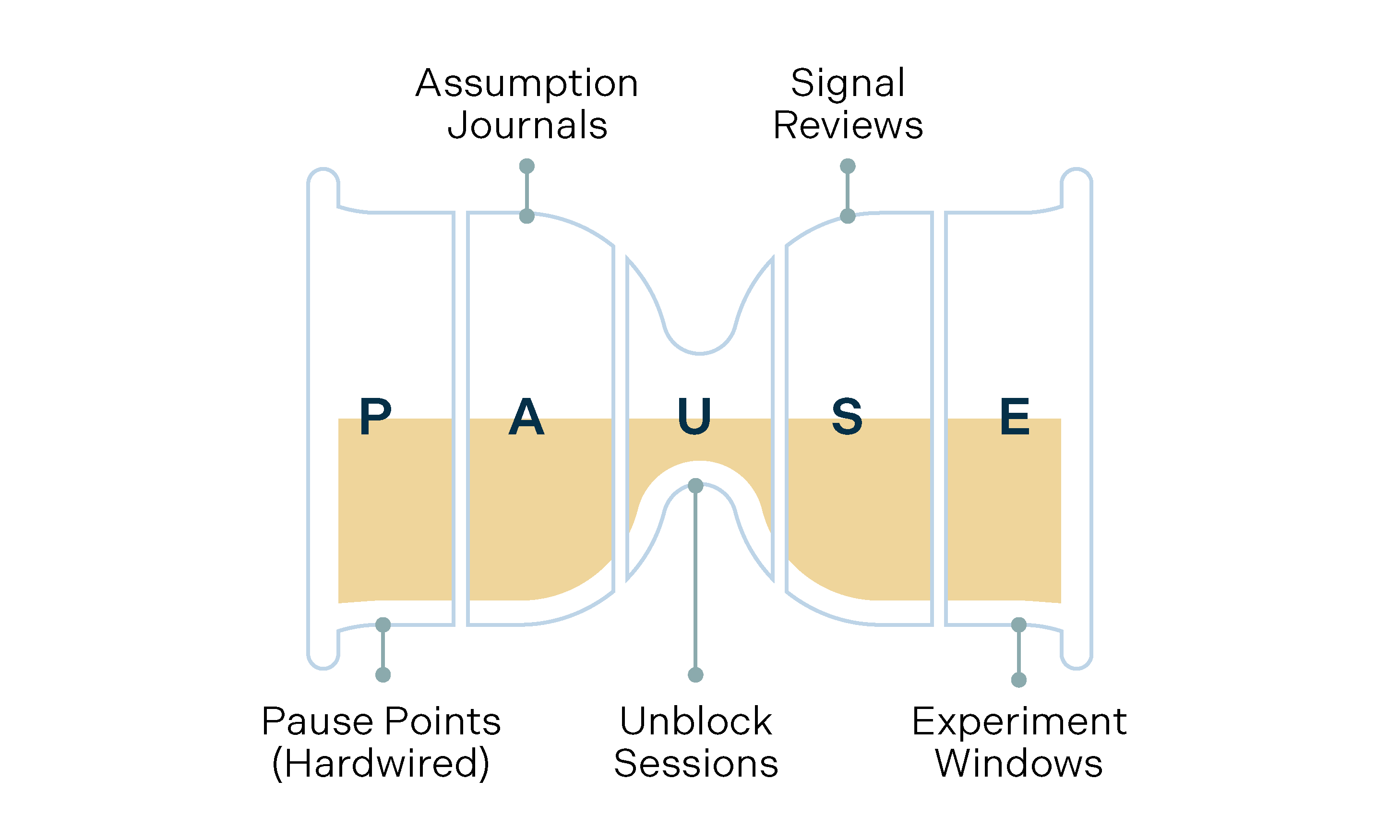
The Framework: PAUSE Budgeting
To make reflection repeatable—and defensible to CFOs and PMOs—treat it as a planned mechanism, not an optional habit. Use PAUSE:
P — Pause Points (Hardwired)
Insert structured reflection at predictable intervals: end of sprint, end of milestone, pre-go-live. These are gates, not “if time permits” sessions. Time-box them. Protect them.
A — Assumption Journals
For major choices, record: decision, rationale, assumptions, and what would change the decision. This one artifact reduces “decision recycling” because context doesn’t evaporate after the meeting.
U — Unblock Sessions
Run 45-minute “friction clinics” focused on one question: What is slowing delivery that isn’t on the plan? Assign an owner. Set a due date. Remove one rock.
S — Signal Reviews
Compare dashboards with frontline truth. If the report says “green” but operations feels “red,” treat it as a trigger: reconcile reality now, not during crisis week.
E — Experiment Windows
Reflection without testing becomes opinion. Every pause should produce at least one low-cost test: a customer call, a process pilot, a sample audit, a prototype.
What Good Looks Like
When reflection is institutionalized, you see it in operating rhythm—not rhetoric:
From activity → learning: progress is measured by assumptions validated and risks retired, not tasks completed.
From status reporting → decision closure: meetings end with a logged decision and a revisit trigger, not “we’ll align offline.”
From heroic recovery → systematic prevention: issues are caught at pause points before they become multi-week delays.
How to Execute: Three Moves to Fund the Pause
Add reflection sprints to the plan. Allocate 2–4 hours at the end of each iteration for sense-making (not status). If needed, label it “Optimization Time” to match executive language.
Mandate the decision log. No phase gate without a published record of decisions, assumptions, and revisit dates.
Measure the rework rate. Track hours spent fixing prior work vs. creating new value. Then show the CFO the math: reflection is cheaper than rework.
Risks and Trade-offs
Reflection theater: sessions become complaint fests.
Mitigation: require outputs—3 assumptions to test, 1 decision to close, 1 process to retire.
Over-pausing: too many checkpoints slow momentum.
Mitigation: scale pause frequency to risk. High-risk work gets more gates; low-risk work gets lighter controls.
Bias-for-action backlash: leaders interpret pausing as softness.
Mitigation: frame reflection as trajectory correction—speed applied in the right direction.
Leadership Questions
Are we budgeting for motion (meetings) or progress (decisions)?
What is our current rework rate—and how much capital is it burning?
Which decisions keep returning in different forums because closure is weak?
If we paused for four hours this week to test our top three assumptions, would we save four weeks next month?
Do our plans allow for thinking—or only for doing?



.svg)