Wisdom at Scale: Preserving Human Judgment in AI-Augmented Organizations
August 14, 2025
8 min read
When AI enters the enterprise, it doesn’t just speed up work—it rewires how decisions get made. The risk isn’t that machines will “replace” leaders. The risk is that leaders will outsource judgment by accident.
Key takeaways
Treat judgment as an operating capability. If human decision ownership isn’t designed into the system, AI becomes the default decider—quietly and quickly.
Separate automation from authority. AI can draft, triage, forecast, and recommend; it must not inherit accountability, ethics, or risk acceptance.
Hardwire oversight into workflows (not committees). Embed sampling, exception flags, and decision logs directly into the process so speed and control scale together.
Measure decision health—not just model speed. Track rework rates and assumption accuracy to detect “judgment drift” before it becomes cultural muscle loss.
Why This Matters Now
Across the GCC, AI is shifting from experimentation to expectation. Workplace adoption is moving faster than prior tech waves, and employees are using these tools even when organizations haven’t redesigned work around them.
That mismatch—high usage, low operating clarity—is where risk grows. Not only cyber risk or compliance risk, but decision risk: people acting on outputs they don’t fully understand, because the tool is fast, confident, and always available.
In the Gulf, where legitimacy, reputation, and governance defensibility carry real operating weight, an unexplainable decision isn’t a minor technical flaw. It’s a leadership exposure.
Share
The Real Risk: Judgment Drift
Most AI failures aren’t explosions. They’re erosions.
Judgment drift is what happens when “the model said so” becomes an acceptable rationale. Over time, teams stop doing the mental work of weighing trade-offs because the machine supplies a neat answer. Research and reporting increasingly link heavy reliance on generative tools with reduced critical thinking and higher cognitive offloading.
You see this show up in three patterns:
Rubber-stamp decisions: outputs accepted with minimal challenge.
Consensus laundering: AI used to avoid conflict (“the numbers decided”), even when the choice is values-based.
Responsibility fog: when outcomes go wrong, accountability fractures—vendor, IT, business—all pointing elsewhere.
This is how “augmentation” becomes “abdication.”
Operating Principle: Automation With Accountability
The aim isn’t to slow AI down. It’s to keep human authority where it belongs: setting risk appetite, defining values, owning outcomes, and protecting trust.
A useful rule: AI provides options. Humans close trade-offs.
If your operating model doesn’t make that explicit, the organization will default to convenience—and convenience will quietly rewrite governance.
Public-sector guidance in the UAE emphasizes responsible use, governance, and control principles precisely because AI changes decision dynamics, not just productivity.
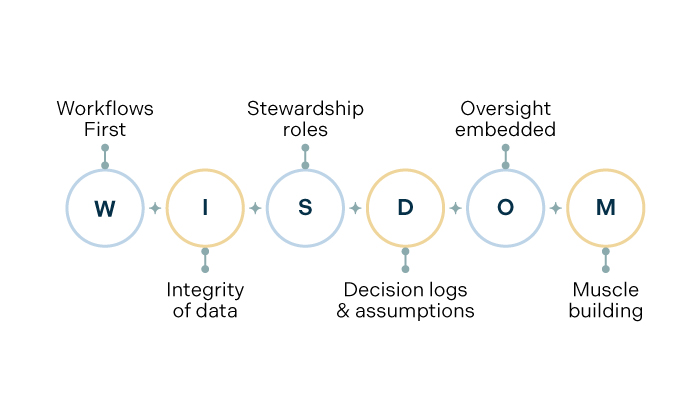
The Framework: WISDOM
To scale AI without shrinking human accountability, use WISDOM—a practical operating model for “wisdom at scale.”
W — Workflows First (not use cases)
Don’t start with “Where can we use GenAI?” Start with “How does work move?” Map triage → draft → approval → execution. Insert AI where it reduces friction without removing human sign-off for high-stakes steps.
I — Integrity of data
AI amplifies what it touches. If KPI definitions are debated today, AI will industrialize the confusion tomorrow. Data hygiene is not housekeeping; it’s decision infrastructure.
S — Stewardship roles
Assign a named business steward for every AI-enabled workflow. The “AI team” supports; the business owner remains accountable. Authority cannot be outsourced.
D — Decision logs & assumptions
For material decisions, require a one-page “Decision Note”: what AI recommended, what humans accepted/rejected, and why—plus assumptions and revisit triggers. This prevents re-litigation and protects auditability.
O — Oversight embedded
Avoid committee theater. Embed controls into the workflow: exception flags, threshold gates, and random sampling. This aligns with broader human-oversight principles for automated decision-making.
M — Muscle-building
Capability isn’t a workshop; it’s a habit. Train micro-skills in context: how to validate outputs, spot hallucinations, detect bias, and escalate responsibly—so teams don’t lose first-principles thinking.
What Good Looks Like
Organizations that preserve judgment show visible shifts:
From AI answers → AI options (leaders close the trade-off).
From trust the tool → trust the process (explainable, auditable decisions).
From speed at any cost → speed with safeguards (cycle time drops and rework falls).
6) A 30-Day “Judgment Sprint”
Run a short, practical reset:
Pick three workflows (high-volume, moderate-risk): triage, forecasting, drafting.
Baseline metrics: cycle time, error rate, rework.
Write one-page guardrails: what must be human-approved, by whom.



.svg)