Beyond Flattened Hierarchies: Redesigning Middle Management as a Strategic Operating Model
February 6, 2025
8 min read
Key takeaways
Redesign the “middle” as coordination mechanisms, alignment, coaching, and conflict resolution, not a layer of approvals, so speed does not become noise.
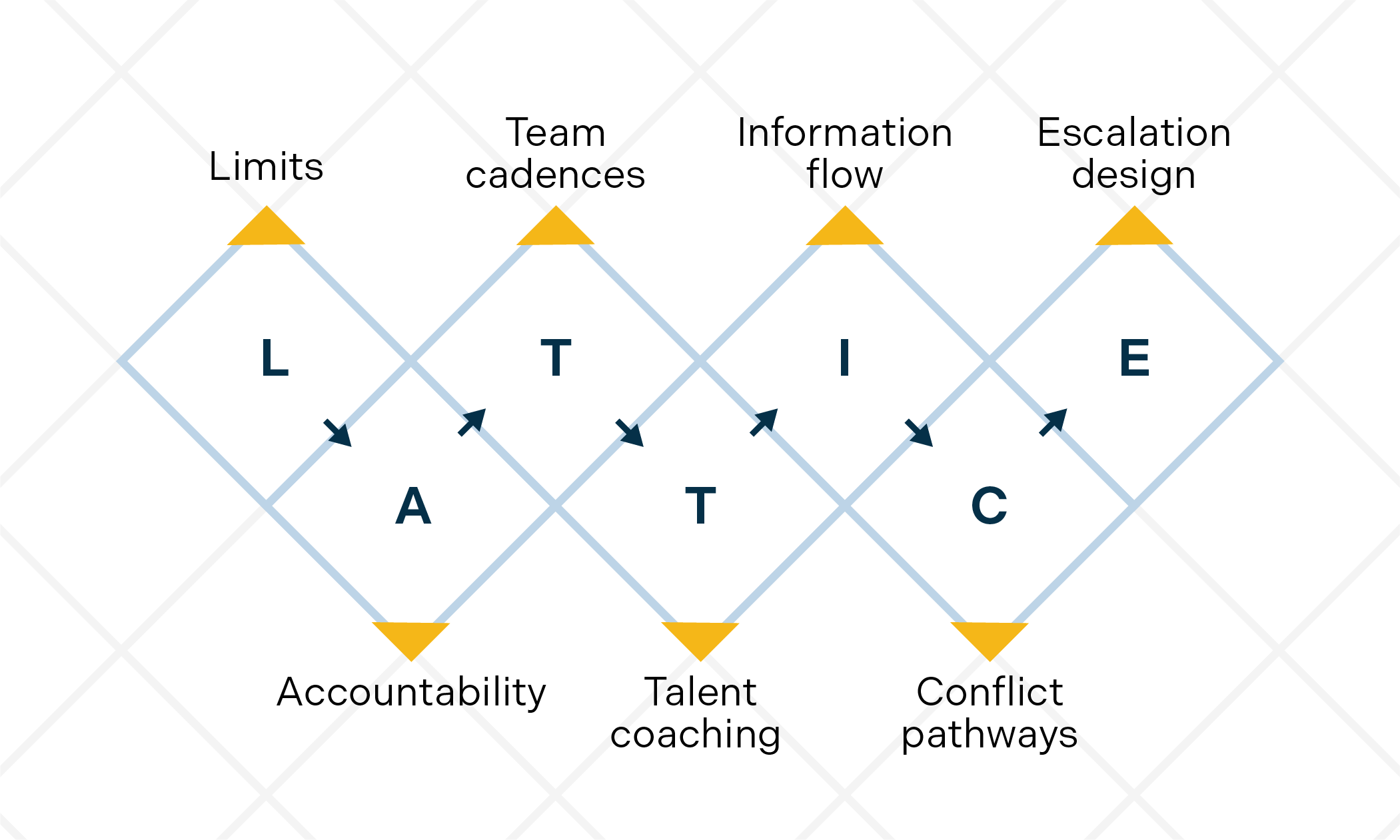
Build a LATTICE system, Limits, Accountability, Team cadences, Talent coaching, Information flow, Conflict pathways, Escalation design, to make autonomy safe.
Replace status meetings with decision clarity through shared dashboards, decision logs, and fast resolution pathways for cross team blockers.
Protect coaching capacity as spans widen, flattening works only if capability building becomes a standard process, not an optional manage
Across industries, organizations are flattening, widening spans of control, pushing decisions closer to the edge, and stripping out layers that feel slow. The intent is speed. The unintended result is often friction.
Workforce data reflects the direction of travel: in 2024, middle managers reportedly made up 29% of layoffs, and openings for middle management roles have fallen about 40% since 2022, suggesting companies are actively thinning the layer. But a “missing middle” is not automatically a productivity gain. When the layer is removed without replacing the coordination system it provided, organizations do not become agile, they become noisy.
This is especially relevant in GCC family enterprises. Multi entity structures, cross border operations, and reputation sensitivity create complexity that requires more alignment discipline, not less. Flattening can still work, but only if leadership is redesigned as a system, not as a reporting line.
Share
What’s Changing
Flattening is accelerating for three reasons:
Speed and cost pressure. Fewer layers promise faster decisions and lower overhead.
Digital coordination tools. Dashboards and collaboration platforms make hierarchy feel optional, until dependencies collide.
More cross functional work. Strategy now travels through shared outcomes, customer experience, supply chains, group synergies, not functional silos.
But flattening changes the job underneath the org chart. As spans widen, leaders have less time for coaching, fewer natural translation points between strategy and execution, and less bandwidth to resolve cross team trade offs. Research and commentary in HBR and HBS Working Knowledge increasingly point to the same conclusion: the future is not “no middle managers,” but different middle managers, more coaching and collaboration, less command and control.
The Real Problem Leaders Underestimate: The Coordination Void
Board level failures in flattened organizations rarely happen because teams lack data or ambition. They happen because the organization loses control without drag, the ability to coordinate priorities and manage trade offs without returning to bureaucracy.
Middle management has historically done three forms of “invisible work” that do not disappear just because the layer is cut:
Coordination: aligning priorities across functions and entities
Coaching: developing capability, performance, and judgment
Context translation: turning strategy into “what changes this week”
When that work is not replaced by explicit mechanisms, four symptoms tend to show up fast:
Execution friction. Senior leaders become the new bottleneck as small decisions escalate upward.
Priority divergence. “Autonomous” teams move fast, but in conflicting directions, driving expensive rework.
Talent erosion. Coaching thins out, feedback becomes sporadic, and capability building becomes accidental.
HBR has argued that eliminating the middle outright is often a costly mistake because mid level leaders connect the organization, develop talent, and translate direction into execution. The point is not to preserve titles. It is to preserve the functions that keep performance coherent.
A practical model: LATTICE coordination
Flattening works when hierarchy is replaced with a usable network, clear enough to coordinate, light enough to move. One way to build that is with a LATTICE: seven coordination elements that substitute mechanisms for layers.
L - Limits (Decision rights): define what teams can decide independently and what triggers escalation.
A - Accountability (Outcome ownership): assign named owners for end-to-end outcomes, not just functional tasks.
T - Team cadences (Operating rhythm): install weekly priority resets and cross-team dependency reviews.
T - Talent coaching (Capability building): standardize coaching expectations and protect time for it.
I - Information flow (Single truth): use decision logs and shared dashboards to reduce status-meeting dependency.
C - Conflict pathways (Resolution design): make disagreement safe and structured, with clear routes to resolve blockers.
E - Escalation design (Exception handling): define escalation triggers and service levels (e.g., cross-team blockers resolved within 72 hours).
This is what replaces the old middle layer. Not a band of approvers, a set of connecting mechanisms that make autonomy safe.
What Good Looks Like
In organizations that flatten successfully, you see changes in behavior, not just structure:
From approvals → guardrails: teams move quickly because authority boundaries are explicit.
From heroic managers → scalable coaching: development is a process, not a personality trait.
From status updates → decision logs: key decisions are documented with assumptions and revisit triggers.
From hidden conflict → designed resolution: trade offs surface early and close cleanly.
A useful test: if you removed a mid level layer tomorrow, would the organization still align priorities, develop people, and resolve trade offs, without turning the CEO and board into the bottleneck?
How to Execute: Five Steps
Audit the invisible work. Identify the coordination and coaching currently provided by the middle layer. Output: “middle value inventory”, alignment, coaching, translation tasks.
Formalize decision rights for the top 20 recurring decisions. Output: decision rights matrix plus escalation triggers.
Install two cadences that protect alignment. Weekly dependency review, monthly “stop list” to retire low value work. Output: operating rhythm plus templates.
Redesign the manager role as a connector. Focus on coaching, dependency management, and conflict resolution. Output: role charter plus coaching expectations.
Measure what flattening is supposed to improve. Cycle time, rework rate, clarity of priorities, coaching frequency.
Risks and Trade Offs
Manager overload: wide spans can degrade coaching quality. Mitigate by simplifying admin work and protecting coaching time.
Governance drift: autonomy without guardrails leads to fragmentation. Mitigate with decision rights and escalation design.
Shadow hierarchies: informal influence replaces transparency. Mitigate with conflict pathways and decision logs.
Career path confusion: fewer “manager titles” can weaken progression. Mitigate by defining progression through scope, skills, and impact, not headcount.
Leadership Questions
Which middle manager activities have we deleted, and what mechanism replaced them?
Where do we need fewer approvals, and where do we need more clarity?
Are managers acting as gatekeepers, or accelerators of autonomy?
If spans widened, what did we simplify to protect coaching quality?
What conflicts are we managing socially that should be designed into the operating model?


.svg)