The Capability Lag: When Your Strategy Is Ready but Your People Aren’t
May 6, 2025
8 min read
Transformations rarely fail because the vision is wrong; they fail because the organization’s delivery muscle cannot carry the weight of the new strategy. Here is how to close the gap.
Key takeaways
Diagnose “capability lag,” not “resistance.” Treat execution friction as a systemic mismatch between strategic ambition and current delivery capacity—not a behavioral refusal to change.
Map the work, not the org chart. Identify bottlenecks at interfaces—handoffs, approvals, and decision rights—before reorganizing teams.
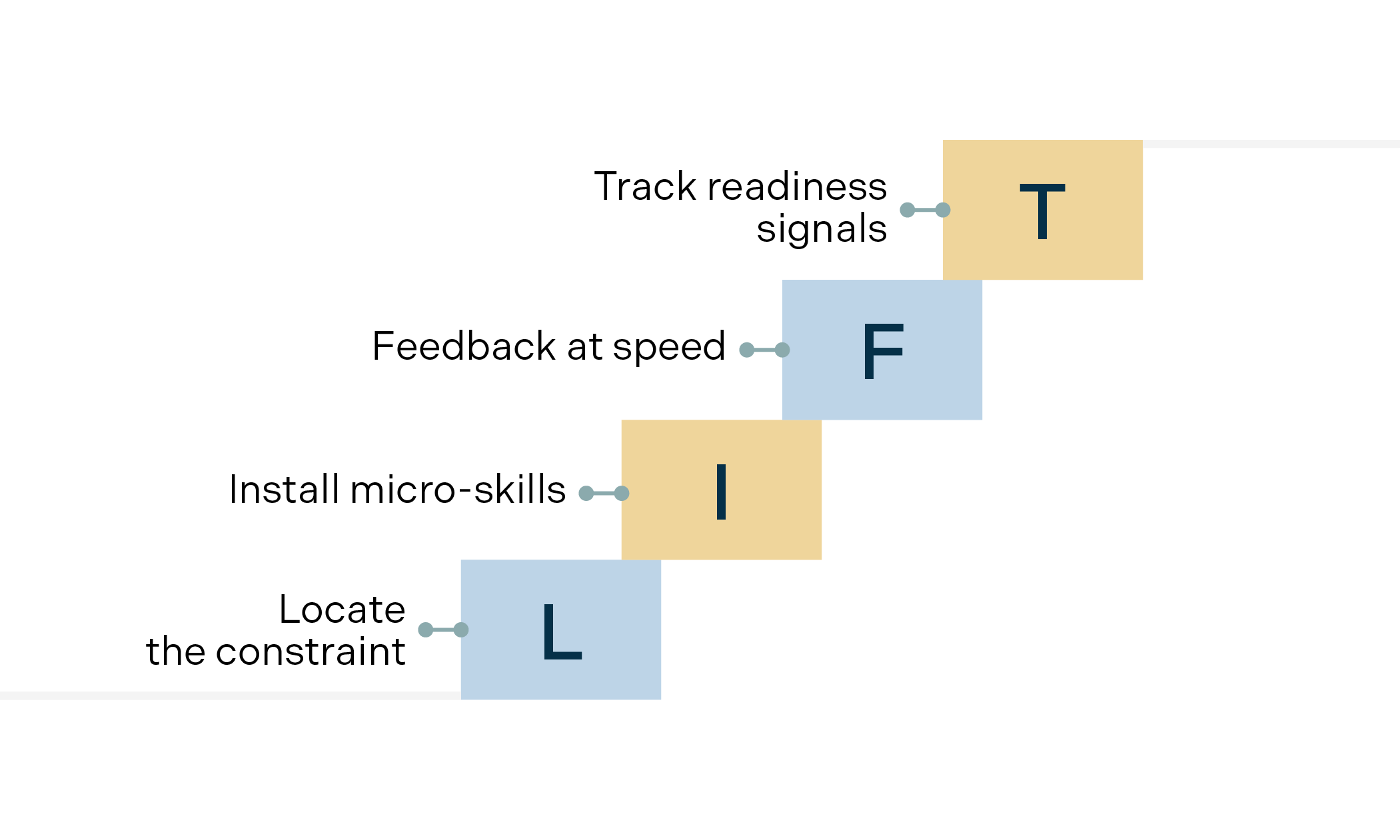
Build skills in the flow of delivery. Use the LIFT loop to build real muscle while shipping: Locate constraints, Install micro-skills, Feedback rapidly, Track readiness.
Measure readiness, not activity. Replace “training hours” with metrics like time-to-confidence, cycle time, and first-time-right output.
Why this matters now
Many GCC transformations don’t fail at strategy. The roadmap is coherent, the Vision 2030 alignment is sharp, and the town hall is convincing. They fail at translation. Monday arrives, the strategy demands digital speed, and execution runs on legacy rhythm.
Leaders often call this “cultural resistance.” That diagnosis is comforting because it suggests a messaging problem. In 2026, it is more often a capability lag: the widening gap between what the new strategy demands and what the operating system—skills, tools, decision rights, and routines—can actually deliver.
In multi-entity family groups and fast-scaling government entities, complexity compounds the lag. Cross-functional work is essential, but the operating model still enforces vertical handoffs. The result isn’t just slowness; its inconsistency—missed commitments, rework, and a gradual loss of stakeholder confidence.
Share
The real problem: system misfit, not employee pushback
Labeling delays as “pushback” implies motivation is the issue. Capability lag is a system issue. It shows up when capable people are asked to deliver new outcomes using old muscles.
Three patterns typically drive this misfit:
New outcomes, old routines. Teams are told to ship in two-week cycles, but procurement, risk, and approvals still run in multi-month loops. The organization demands sprint speed with marathon governance.
Ambiguous decision rights. Authority is “delegated” on paper but remains culturally centralized. The safest action becomes escalation—which turns the C-suite into the bottleneck and trains the organization to wait.
Training detached from delivery. Capability building is treated as an HR event rather than an operational necessity. Learning happens in workshops; performance is demanded in the real world. Without integration, capability doesn’t stick.
The implication is blunt: you don’t fix capability lag with persuasion. You fix it with enablement designed into work.
What leaders should reframe
The organizations that close capability gaps fastest treat capability as a production discipline, not a curriculum. They don’t try to “upskill everyone” as a blanket program. They identify the precise constraints that slow a value stream and build the smallest skills required to remove them.
In this model, managers stop being traffic police. They become multipliers—creating guardrails, coaching judgment, and removing blockers so the team can carry a heavier load without breaking.
The framework: the LIFT capability loop
To build muscle without pausing operations, use LIFT—a loop that strengthens capability while working.
L — Locate the constraint
Pick one value stream (customer onboarding, vendor approval, order-to-cash) and find the step where work queues. Don’t start with the whole enterprise; start where throughput is actually constrained.
I — Install micro-skills
Define the smallest unit of skill that removes the constraint. Not a two-day Agile course—something usable immediately: writing a one-page decision memo, running a 15-minute stand-up, defining “done,” or using an asynchronous approval workflow. Apply it to the live backlog within days.
F — Feedback at speed
Capability is perishable. Establish weekly feedback loops: what worked, what broke, what needs reinforcement. If feedback arrives quarterly, the organization will default back to old behavior.
T — Track readiness signals
Stop counting attendance. Track adoption and performance: time-to-confidence, first-time-right, cycle time from idea to test, and rework rate. Readiness makes investment decisions obvious.
What “good” looks like
When capability lag is closing, behavior changes become visible:
From training events → embedded learning. Skills are built on real work with real consequences.
From escalation → guardrails. Teams move faster because authority boundaries are explicit and safe.
From heroic delivery → systematic throughput. Performance relies on repeatable methods, not on a few “fixers” who know how to bypass the system.
A simple test: if you swapped the top performers out of a team, would the work still ship at the new standard? If not, capability hasn’t been institutionalized.
How to execute: six steps
X-ray a single value stream. Map one critical workflow end-to-end and identify where work queues.
Define the crucial few skills. Identify 3–5 behaviors that remove the bottleneck.
Remove one systemic friction. Kill one approval, report, or meeting that makes the new behavior impossible.
Run a capability sprint. Practice micro-skills on live work over 2–4 weeks with at-the-elbow coaching.
Charter managers as multipliers. Make coaching and guardrails part of the role—not optional heroics.
Review readiness monthly. Use the readiness dashboard to decide whether the capability is ready to scale.
Risks and trade-offs
Training theater. Workshops can masquerade as progress. Mitigate by tying learning to measurable throughput changes.
Manager overload. Coaching fails when managers are buried in admin. Mitigate by clearing capacity first.
Local optimization. Fixing one team can shift the bottleneck downstream. Mitigate by measuring end-to-end flow.
Leadership questions
Where is our strategy outrunning our operating muscle?
Which single capability bottleneck creates most of our delay and rework?
Are we measuring activity—or readiness?
Have we accidentally incentivized escalation by leaving decision rights unclear?



.svg)