Intuition Isn’t Irrational: Making Space for Gut-Feel in a Data-Driven World
April 17, 2025
8 min read
Key takeaways
Use intuition to spot “model blind spots.” Add an explicit “What doesn’t fit?” checkpoint before committing to major decisions.
Treat gut-feel as a hypothesis, not a verdict. Translate instinct into testable signals, then validate with targeted data—not more data.
Design a dual-lens cadence. Separate sense-making (pattern recognition) from proof (evidence review) to reduce analysis paralysis.
Build an escalation rule for instincts. When experienced leaders’ intuition flags risk, require a short “disconfirming search” before proceeding.
Executives aren’t short on information. They’re short on clarity. Many leadership teams have built impressive analytics stacks—dashboards, KPIs, real-time alerts—yet still find themselves surprised by customer shifts, talent exits, or execution failures that “didn’t show up in the numbers.”
This isn’t a failure of data. It’s a failure of decision design. When metrics become the only legitimate language in the room, organizations unintentionally suppress what experienced leaders often contribute best: pattern recognition, context sensitivity, and judgment under uncertainty. The result is a paradox: more measurement, less wisdom.
The implication for GCC organizations—especially complex, multi-entity groups—is significant. When the operating environment moves faster than quarterly reporting cycles, leaders need a decision model that can read weak signals early, not one that waits for lagging indicators to turn red.
Share
The real problem leaders underestimate: metrics can create false certainty
Data is powerful, but it has limits. Metrics are curated representations of reality, not reality itself. Three common failure modes show up in boardrooms:
Instrument fixation: Teams optimize what’s measured, even when what’s measured is no longer what matters.
Lag blindness: Many KPIs confirm problems after they’ve already become expensive.
Analysis inflation: When stakeholders disagree, the default response is often “bring more data,” which delays a decision without improving it.
Meanwhile, intuitive judgment—because it’s harder to “show” in a slide—gets treated as irrational. That’s the mistake. Intuition is often the brain’s compressed learning: experience, exposure, and tacit knowledge retrieved quickly. It becomes dangerous only when it is unchecked, unexamined, or driven by ego.
A practical way to think about intuition
Intuition is not the opposite of rigor. It’s a different kind of input. In practice, it tends to be useful in two situations:
High ambiguity: when the future won’t resemble the past.
High human complexity: when culture, trust, incentives, and informal power matter as much as economics.
Used well, intuition acts like an early-warning system: “Something here doesn’t add up.” Used poorly, it becomes a shortcut: “I just know.” The discipline is to preserve the first and prevent the second.
The framework: the SIGNAL model
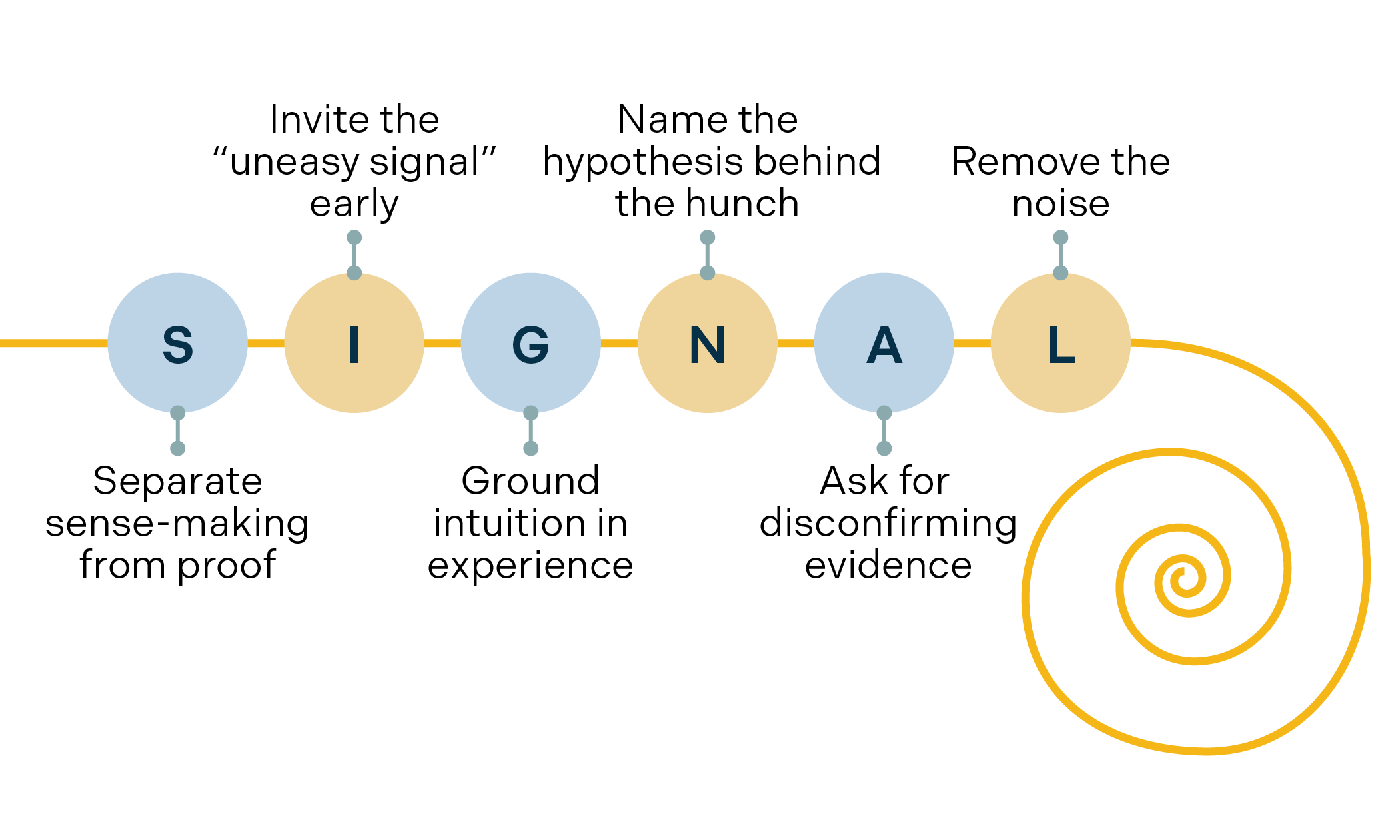
To make intuition usable—and governable—leaders can apply SIGNAL, a simple operating model that integrates gut-feel without surrendering to it.
S — Separate sense-making from proof
Run two distinct moments: first, a sense-making discussion (patterns, narratives, risks). Then, a proof discussion (evidence, thresholds, trade-offs). Mixing them creates noise.
I — Invite the “uneasy signal” early
Before dashboards are debated, ask: “What feels off?” This surfaces weak signals while the room is still open-minded—before positions harden.
G — Ground intuition in experience
Not all intuition is equal. Weight it based on proximity to the domain. A leader with repeated exposure to a pattern (customer churn, regulatory shifts, execution risk) has “trained intuition.” Capture that context explicitly.
N — Name the hypothesis behind the hunch
Convert instinct into a sentence: “I suspect X because Y; if true, we will see Z.” Now the team can test it—quickly.
A — Ask for disconfirming evidence
Require a short “disconfirming search”: What would prove this instinct wrong? This protects against confirmation bias and heroic narratives.
L — Log the judgment
Document the intuition, the supporting evidence, and the decision made. Decision logs reduce re-litigation and build institutional learning: you can later ask whether the instinct was wrong—or the execution.
What good looks like
When organizations integrate intuition responsibly, you see behavioral shifts:
From “data as weapon” → “data as lens.” Numbers inform trade-offs instead of winning arguments.
From “confidence theater” → “calibrated judgment.” Leaders can say, “I’m 60% confident,” and the room knows what to do next.
From “gut-feel = politics” → “gut-feel = input.” Intuition becomes discussable, testable, and improvable.
How to execute: 6 steps
Identify your “high-ambiguity” decisions Objective: focus intuition where it belongs. Output: a short list (e.g., new market entry, key hires, major partnerships, transformation sequencing).
Add a two-question intuition checkpoint Actions: before decisions, ask: “What feels off?” and “What are we not measuring that matters?” Output: a visible list of “uneasy signals.”
Convert instincts into hypotheses Actions: force one-sentence hypotheses with observable signals. Output: 3–5 testable assumptions, not a debate.
Run a disconfirming search Actions: assign someone to challenge the hunch with targeted data, not broad analysis. Output: a short “disconfirming brief.”
Decide with thresholds, not vibes Actions: define what evidence would trigger “go / no-go / revise.” Output: decision thresholds that combine metrics and judgment.
Log the decision and revisit date Actions: document trade-offs and set a review trigger. Output: institutional memory—and fewer circular meetings.
Risks and trade-offs
Bias laundering: Intuition can become a respectable label for preference. Mitigation: require hypotheses and disconfirming evidence.



.svg)