Digital Detox for the C-Suite: Restoring Strategic Attention in an Always-On Age
April 8, 2025
8 min read
Key takeaways
Treat attention as a scarce asset. Protect strategic cognition by shifting from “always-on” availability to scheduled, non-negotiable deep-work windows.
Replace coordination with decision discipline. Move debates out of email/WhatsApp threads and into structured decision forums that end with a verdict.
Design focus into the operating rhythm. Use the RESET framework to institutionalize disconnection as a system capability—not a leader’s personal preference.
Measure what matters. Track decision velocity, meeting load, and rework—not response speed—to prove the ROI of attention management.
The modern executive suite is drowning in a paradox: leaders have more information than ever, but less space to synthesize it. In the GCC, the pressure is amplified by high-velocity agendas—national visions, ambitious growth targets, and complex multi-entity portfolios that keep leadership perpetually “reachable.”
The problem is that “reachable” is not the same as “effective.” When work becomes a continuous stream of pings, leaders lose the cognitive conditions needed for judgment, trade-offs, and creativity. Microsoft’s Work Trend Index highlights how many employees feel overwhelmed by the pace and volume of work—an environment that makes strategic thinking harder, not easier.
Share
The Real Problem Leaders Underestimate: Attention Debt
Many leadership teams think they have a decision problem (“we’re slow”). Often, they have an attention problem (“we’re fragmented”). Attention debt accumulates when reaction becomes the default operating mode. The organization gets fast at forwarding, commenting, and escalating—but slow at deciding.
Three symptoms show up quickly:
The “Shadow Board” on WhatsApp. Decisions drift into informal channels, bypassing governance and creating ambiguity over what was approved, by whom, and on what basis.
Escalation inflation. Without clear guardrails, small issues climb to the C-suite because it’s easier to interrupt than to decide locally.
Innovation paralysis. Leaders spend their best hours “running the business,” leaving the “change the business” agenda to evenings—when cognition is weakest.
Organization Behavior research work on interruptions and “attention residue” is blunt: task-switching leaves cognitive residue behind, reducing quality on the next task. In leadership roles, that residue becomes decision noise.
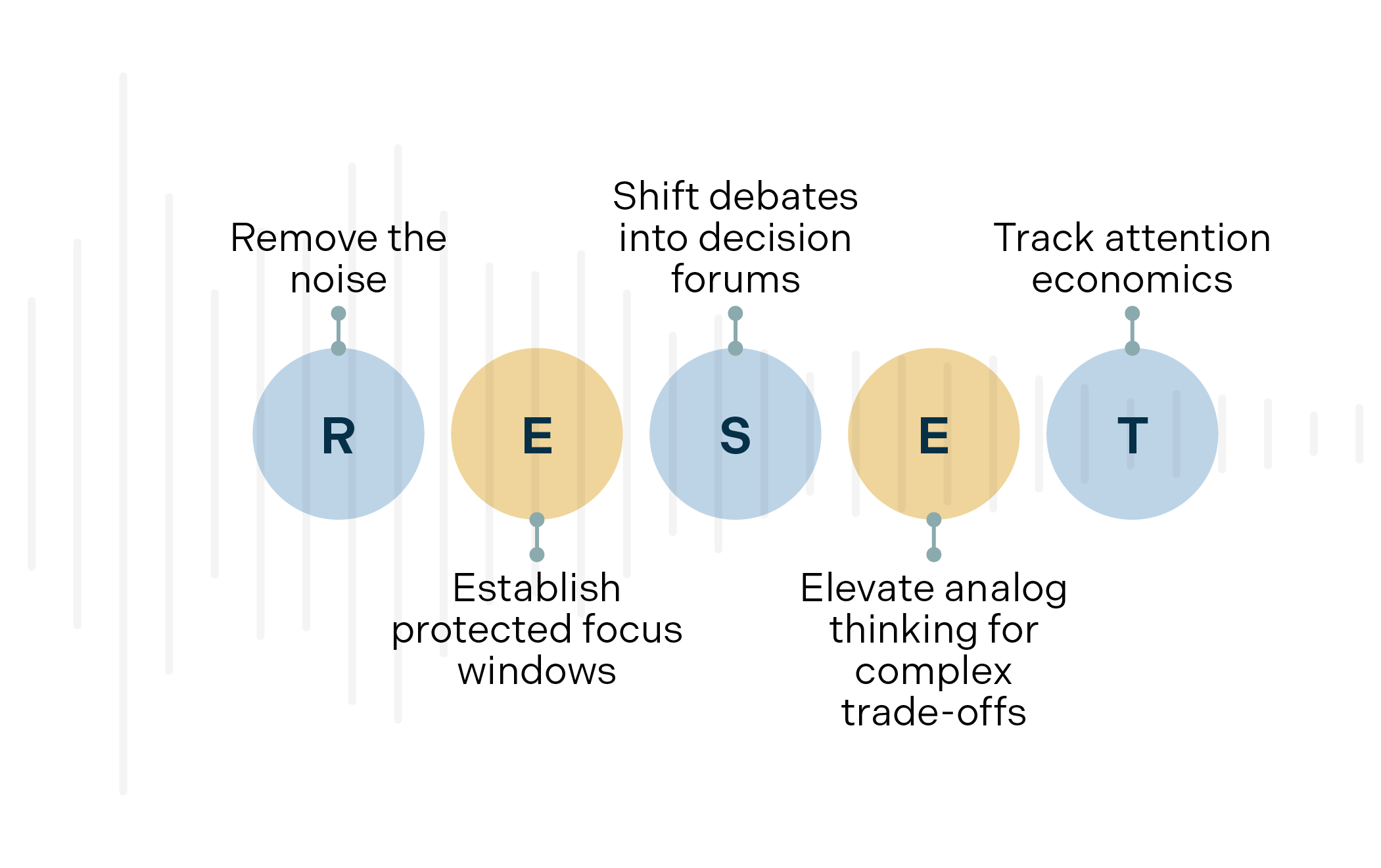
The Framework: The RESET Model
A digital detox only works when it becomes governance—designed into how information moves and decisions get made. RESET is a practical way to do that.
R — Remove the noise.
Audit the leadership “surface area”: notifications, groups, recurring dashboards, and FYI emails. Reclassify “urgent.” In many GCC firms, a simple rule creates instant clarity: WhatsApp is for coordination, not approval.
E — Establish protected focus windows.
Block two meeting-free windows per week for the top team during peak cognitive hours. This is not personal productivity—it’s an enterprise control point that protects strategic synthesis.
S — Shift debates into decision forums.
Replace “debate by thread” with structured forums designed to decide. Require pre-reads, define the decision owner, and end with a recorded outcome. McKinsey’s research on decision effectiveness consistently points to the same pattern: speed and quality improve when decision rights and processes are explicit.
E — Elevate analog thinking for complex trade-offs.
For strategy, risk, and people decisions, revert to whiteboards and face-to-face dialogue. Analog tools reduce context switching and restore nuance—especially valuable in high-context GCC leadership cultures.
T — Track attention economics.
Measure attention like capital. Track meeting load per decision, decision cycle time, after-hours interruption rate, and rework caused by unclear direction. Bain’s work on organizational “time, talent, and energy” reinforces that hidden friction—not visible effort—often drives performance loss.
What Good Looks Like
You can see attention discipline in behavior, not slogans:
From “always available” → “reliably decisive.” Fewer responses, clearer direction.
From data dumps → decision-grade inputs. Short briefs focused on options and trade-offs.
From meetings to align → meetings to decide. Fewer sessions, tighter agendas, recorded outcomes.
From escalation culture → delegated authority. The C-suite becomes the exception handler, not the routing center.
How to Execute: Five Steps
Run an attention audit (one week). Output: top three interruption sources and the meetings that produce no decisions.
Define escalation protocols (“rules of engagement”). Output: a one-page guide for what qualifies as immediate interruption vs. routed review.
Install two protected focus blocks (team-wide). Output: a consistent rhythm (e.g., two 90-minute blocks) across the leadership team.
Launch a decision forum (replace the weekly ops meeting). Output: pre-read template, decision owner, decision log, and a “no pre-read, no decision” rule.
Quarterly signal review. Output: trend lines on decision cycle time, meeting load, and rework—plus a list of rituals to retire.
Risks and Trade-offs
Perceived detachment. Less responsiveness can be misread. Mitigation: communicate the “why” and maintain high-touch office hours.
Shadow channels persist. People bypass the process if it’s slower. Mitigation: make the decision forum faster than the workaround.
Bottlenecks shift upward. If authority isn’t delegated, focus time becomes organizational delay. Mitigation: pair RESET with a refreshed DoA and decision-rights clarity.
Leadership Questions
Where are we mistaking responsiveness for impact?
Which strategic decisions are stuck because we’re debating inputs—not trade-offs?
If the ExCom disconnected for four hours, would the organization panic—or execute?
What recurring “urgent” routines can we retire to buy back 10% of cognitive capacity?


.svg)