Beyond the Family Business Crossroads: Navigating Succession in the Age of AI
January 7, 2025
8 min read
Why TRUST — not tools — will decide whether legacy compounds or fragments
Key takeaways
• Codify values into decision guardrails so AI enabled growth does not drift from the family’s legacy principles during succession.
• Clarify decision rights early, who decides, who overrides, what must remain human led, to prevent pilot sprawl and accountability confusion.
• Treat capability as succession infrastructure by building role based AI literacy for the board, executives, and operators, not just the tech team.
• Shift from black box adoption to trust by design with traceable decisions, documented controls, and repeatable governance rhythms that sustain legitimacy.
Family enterprises have always played the long game: patient capital, reputation discipline, and continuity across decades. What’s different now is the collision of two structural forces: the Great Wealth Transfer and the rapid normalization of generative AI.
Cerulli Associates projects $84.4 trillion will transfer through 2045 (to heirs and charities), reshaping who holds capital and how decisions get made. In parallel, Stanford’s 2025 AI Index reports that 78% of organizations used AI in 2024(up from 55% in 2023), signaling that AI is moving from experimentation to default operating reality.
For family businesses, this isn’t simply a technology upgrade. It’s a succession challenge—because AI changes decision-making, accountability, and the mechanics of stewardship. The underlying risk is a “Legacy Gap”: the distance between what historically made the enterprise strong (relationships, intuition, centralized control, unwritten context) and what now creates advantage (data discipline, faster execution, and transparent governance).
Family businesses matter at scale. The Family Firm Institute is commonly cited as estimating family businesses contribute 70–90% of global GDP—which means how they navigate this transition will shape entire economies, not just individual firms.
Share
The trust problem: NextGen ambition meets “black box” anxiety
NextGen leaders typically push for speed—modern systems, analytics-driven growth, professionalized governance. Incumbent leaders often worry about something else: risk andopacity. If an AI model recommends an action, who is accountable? If a decision is challenged (internally, by regulators, or by counterparties), can the enterprise explain and defend it?
When this isn’t resolved, AI adoption fragments: pilots proliferate, scale stalls, decision cycles slow, and talent becomes frustrated (“we have tools, but nothing really changes”). The remedy is not “more AI.” It’s a governance-and-capability architecture that keeps the family’s identity intact while enabling AI-native performance.
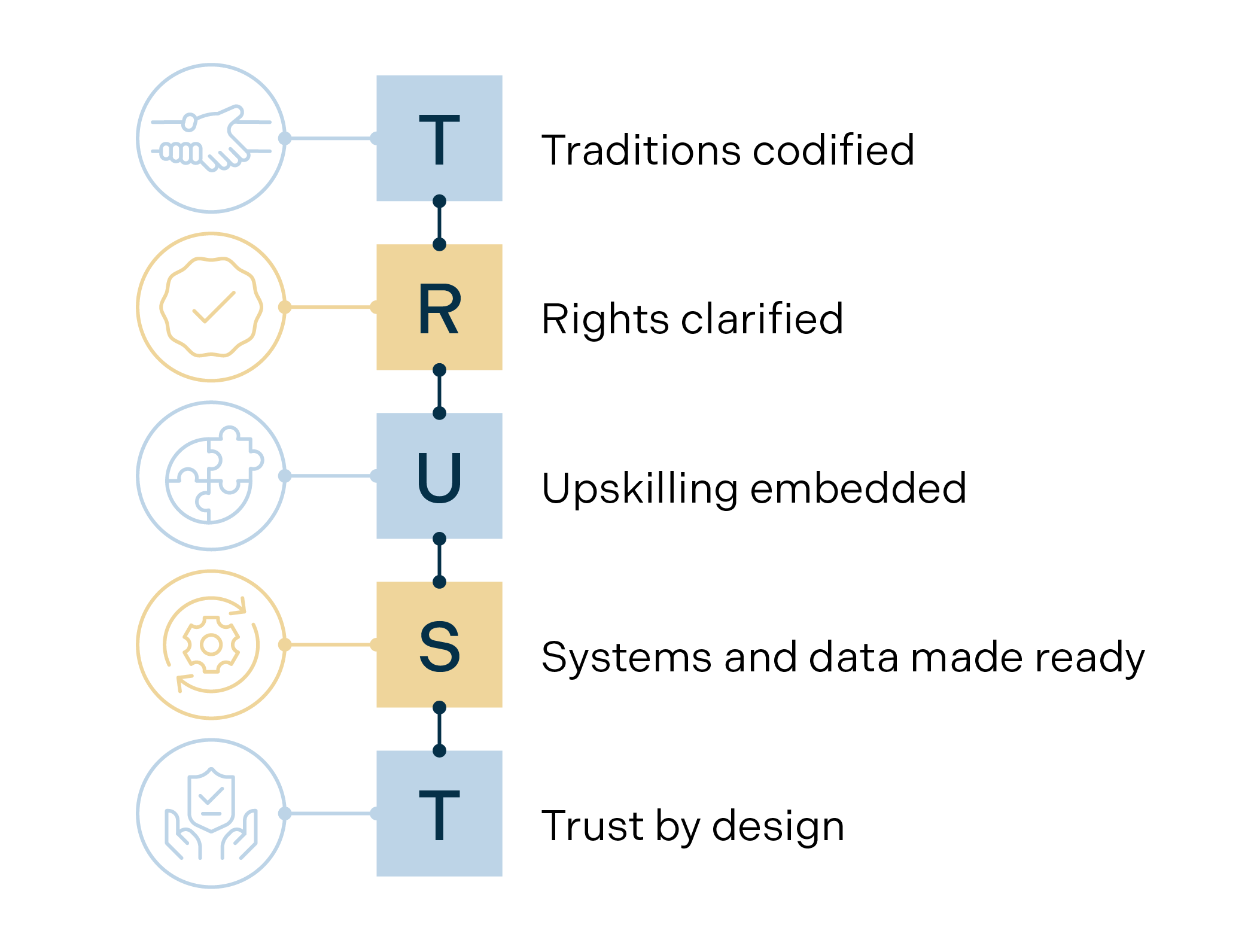
A practical way to do that is the TRUST framework.
TRUST: A board-ready framework for AI-enabled succession
T — Traditions codified | values into operational guardrails
Most families have values; fewer have decision guardrails. Codify what “stewardship,” “reputation-first,” or “fairness” means in real business choices: credit approvals, hiring, pricing exceptions, supplier disputes, and investment risk.
Make it concrete: define 10–15 recurring “high-stakes decisions” and attach principles to each.
Output: a one-page Legacy Principles Charter that becomes the benchmark for AI use cases (“AI may assist, but it must not violate these principles.”).
R — Rights clarified | who decides, who overrides, who owns outcomes
AI introduces ambiguity: recommendation vs. decision, automation vs. accountability. Define what is human-led, what is AI-assisted, and what requires human sign-off (especially for employment, credit, compliance, and safety decisions).
The World Economic Forum has emphasized the need for guardrails—transparency, governance, and oversight—to build trust in generative AI systems.
Output: a Decision Rights Matrix spanning Board / Family Council / CEO / ExCo / Functions, plus “human-in-the-loop” rules.
U — Upskilling embedded | succession readiness includes AI literacy
Capability is now succession infrastructure. AI doesn’t fail because leaders lack ambition; it fails because teams can’t translate use cases into redesigned workflows, measurable outcomes, and controls.
The World Bank’s Digital Progress and Trends Report 2025 highlights “AI foundations” needed for inclusive progress—reinforcing that skills and institutional readiness are prerequisites, not afterthoughts.
S — Systems and data made ready | from pilots to reusable “data products”
Scaling fails when every pilot rebuilds data from scratch. Family groups often have fragmented entity data (customers, vendors, assets, HR, finance) that prevents repeatable AI deployment.
Output: a small use-case portfolio (5–8) tied to outcomes, supported by reusable “data products” (e.g., customer 360, vendor risk profile, asset registry) with named owners, quality standards, and access rules.
T — Trust by design | governance that matches the UAE context
In the UAE, responsible AI expectations are becoming explicit. The UAE Charter for the Development and Use of AI(issued 10 June 2024) sets national principles to guide responsible AI development and use. At the same time, the UAE PDPL (Federal Decree-Law No. 45 of 2021) establishes a baseline for personal data governance and safeguards.
Ask a simple question: does your succession plan transfer titles and shares, or does it also transfer the enterprise’s decision system—the governance, data discipline, skills, and operating rhythms that will determine performance in an AI-native economy?
In the age of AI, legacy is preserved less by resisting change and more by governing change—so technology strengthens trust instead of eroding it.


.svg)