Decision Debt: The Hidden Cost of Postponed Strategic Choices
May 27, 2025
8 min read
In fast-moving organizations, the most expensive decisions are rarely the ones you get wrong. They are the ones you never make. Here is how to pay down the backlog—without turning governance into bureaucracy.
Key takeaways
Treat decision debt as a tangible operating cost. Every postponed choice compounds into delay, rework, and organizational friction—it is not prudence; it is liability.
Replace “alignment” with decision discipline. Move from consensus-seeking to structured Decision Forums with defined rights and clear exit criteria.
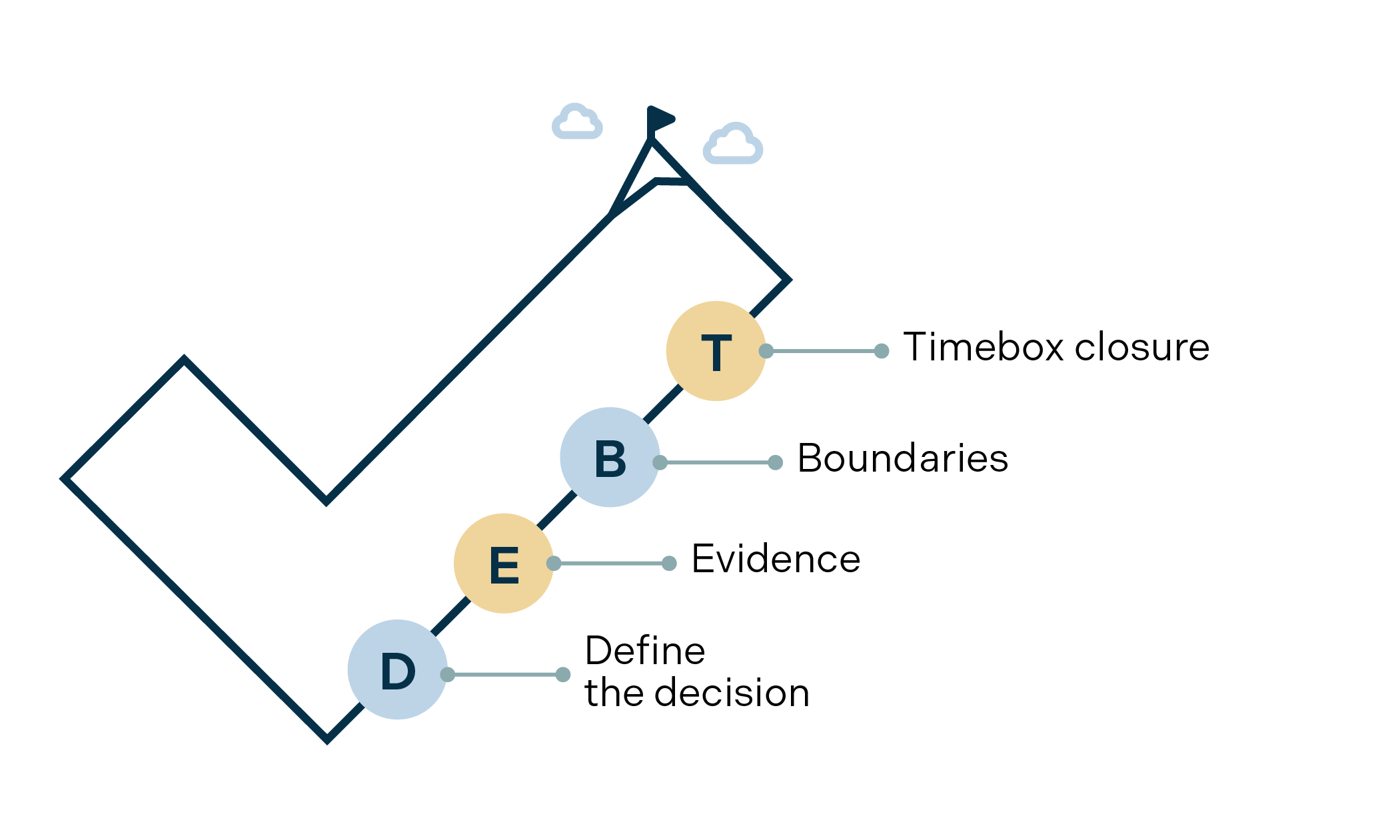
Use the DEBT framework to force closure.Define the decision, limit the Evidence, set Boundaries, and Timebox the outcome to prevent re-litigation.
Measure velocity, not just quality. Track cycle time from “question asked” to “decision executed” to reveal where governance is acting as a brake.
Decision debt is what happens when an organization keeps running—but avoids choosing. It often wears the mask of sophistication: “Let’s wait for more data,” “Let’s align one more stakeholder,” “Let’s review in the next steering committee.” On paper, this looks like rigor. On the ground, it produces ambiguity.
And ambiguity is expensive. When decisions are delayed, teams don’t stop working; they start hedging. They build parallel options. They re-check assumptions. They escalate exceptions. They produce decks to “socialize” a direction that no one has the authority to lock. The visible cost is time. The hidden cost is momentum.
In the GCC, decision debt compounds faster because the environment is moving faster. National agendas demand delivery at speed, while many large organizations—especially multi-entity family groups—still operate with cultural norms that favor consensus and face-saving. That “Majlis mindset” is powerful for cohesion, but it can make definitive “no” decisions difficult. As groups expand across borders, integrate JVs, and pursue technology-led transformation, the ambiguity spreads faster than clarity.
When the formal system can’t close, the informal system does. Decisions drift into corridor conversations and WhatsApp threads—quick, convenient, and invisible to audit. That is not agility. It is governance leakage.
Share
The real issue isn’t data. It’s decision rights.
Most leadership teams diagnose slow decisions as an information problem. The reflex is predictable: more dashboards, more KPIs, more analysis. But decision debt rarely comes from missing data. It comes from missing authority.
When it’s unclear who has the final vote versus who simply provides input, the organization defaults to consensus theater: everyone is consulted, no one is accountable, and meetings end with “let’s regroup” rather than “here’s the call.” Over time, unresolved trade-offs accumulate into a backlog that slows every dependent initiative—hiring, capex, vendor selection, product launches, portfolio prioritization.
This is where governance quietly flips from steering wheel to handbrake.
A Practical Stance
You do not need more time. You need better friction.
That sounds counterintuitive, but it’s true: speed comes from a designed constraint. High-performing organizations introduce the right kind of friction—clear decision rights, a forced deadline, and a documented outcome—so choices close cleanly and don’t return every month in a new meeting with a new deck.
A “good enough” decision made today is often better than a perfect decision made next month—because the market moves, costs compound, and talent loses confidence when leadership cannot commit.
The goal of governance is not to eliminate risk. It is to process risk at speed, with discipline.
The DEBT framework
A simple operating mechanism can remove emotion and enforce closure. Use DEBT:
D — Define the decision (single sentence)
If the decision cannot be written plainly, you’re still discussing. Replace vague agenda items (“Discuss procurement strategy”) with decision statements (“Approve Vendor X for AED Y under terms Z”).
E — Evidence (decision-grade inputs)
Most delays come from metric sprawl and data disputes. Limit inputs to a small set of decision-grade metrics (usually 3–7) that the leadership team trusts. If you’re debating definitions in the meeting, the meeting is already failing.
B — Boundaries (decision rights)
Clarify who recommends, who provides input, who has veto rights, and who decides. A RAPID-style clarification works well—but the key is tightening the “Agree” role. Unbounded veto power is paralysis disguised as participation.
T — Timebox closure
Put a decision SLA on every item: “We will decide by Thursday 2 pm.” If the deadline passes, the decision defaults to the recommendation or escalates—no indefinite drift.
DEBT turns decision-making into a repeatable discipline, not a personality contest.
What good looks like
Organizations that pay down decision debt look different in how they operate:
Meetings exist to decide, not to update. Updates move to pre-reads; the room is for trade-offs and closure.
Decisions are logged and auditable. A simple Decision Log prevents re-litigation and clarifies downstream execution.
Leaders operate with sufficient certainty. They decide with 70% confidence, record assumptions, and course-correct through defined revisit triggers.
The cultural shift is subtle but powerful: less noise, fewer escalations, cleaner execution.
How to execute in five moves
1) Audit the backlog Review the last three ExCom minutes. What was discussed but not decided? That list is your debt pile.
2) Charter a Decision Forum A weekly 30–60 minute forum with one purpose: make decisions. No status updates.
3) Enforce a one-page memo Every decision arrives with a standard one-pager: the choice, trade-offs, risks, recommendation.
4) Name the “D” before the meeting If the decision is unclear, the meeting is theater.
5) Log and cascade within 24 hours Publish the decision, owner, and next steps—fast—so the organization can move.
Risks and trade-offs
Timeboxing can create premature calls if leaders confuse speed with recklessness. The mitigation is simple: document assumptions and set revisit triggers. Shadow decisions will persist if the formal process is slower than WhatsApp. The mitigation is also simple: make the official path faster. Finally, watch for pocket vetoes—stakeholders who “agree in the room” but block execution quietly. Record dissent and enforce “disagree and commit” with accountability.
Leadership questions
Where are we delaying decisions because we fear visible trade-offs?
What percentage of leadership time is spent deciding versus coordinating?
Which approvals need a clear decision SLA (hiring, capex, vendors)?
If we removed 20% of recurring meetings, would decision quality truly drop?
Decision debt isn’t a soft issue. It’s a compounding liability. Pay it down, and speed returns—not as chaos, but as disciplined execution.



.svg)