Organisation Design or Organisation Origami? Unfolding Structures That Actually Work
June 19, 2025
8 min read
When the org chart looks elegant but execution collapses, the issue isn’t the boxes—it’s the flow. Here is how to redesign structures that carry real operating load rather than just aesthetic appeal.
Key takeaways
Design for flow, not for form. Start by mapping the seams where value is handed off—customer touchpoints, regulatory junctions, and release cycles—then let the structure follow the work.
Make decision velocity the primary design metric. Push authority to where information is richest. If decisions travel three layers up for approval, the structure is broken—no matter how neat the chart looks.
Replace committee-itis with breathable governance. Use time-boxed decision forums with sunset clauses. If a committee can’t justify itself through decision throughput, retire it.
Prototype the organisation under load. Run “day-in-the-life” simulations before launch. If the structure can’t survive a real week of work on paper, it’s origami.
Across the GCC, reorganisations have become the default response to transformation pressure. New strategies. New ventures. New regulators. New digital delivery demands. And in many boardrooms, the reflex is familiar: redraw the chart.
Yet the post-reorg reality often looks like this: fewer boxes on the slide, more friction in the business. Decision cycles lengthen. Escalations increase. Teams spend weeks negotiating “how we work now.” Leaders feel a strange contradiction—we simplified the organisation, but execution became harder.
That’s because most organisation design still optimises for appearance: symmetry, reporting neatness, elegant spans of control, a crisp narrative for the town hall. But modern performance—in multi-entity groups, cross-border joint ventures, and fast-scaling public entities—depends on something else: speed across seams.
In 2026, the bottlenecks rarely sit inside one function. They sit between functions, between entities, and between governance layers. When those interfaces aren’t engineered, the org chart becomes a gallery piece: beautiful folds, zero lift.
Share
The Real Problem: Org Charts That Hide Work
Organisation origami happens when leaders treat structure as a drawing exercise instead of an execution system. Pretty diagrams promise simplicity, but complexity doesn’t disappear behind dotted lines—it just moves underground.
Here’s what that looks like in practice:
Shadow hierarchies. The formal chart says one thing; influence networks say another. Work flows through “who you know” rather than “who owns it,” creating a parallel system that’s fast but unauditable. In some GCC environments, this becomes “corridor governance” or WhatsApp approvals—efficient in the moment, costly over time.
Permission bottlenecks. Decision rights are theoretically delegated, but culturally centralised. Managers hesitate to decide because the safe move is escalation. The result is predictable: the top becomes the choke point, and everything queues behind a few overloaded people.
“Who owns this?” paralysis. Outcomes are end-to-end (customer experience, time-to-market, compliance), but accountability is local (departments). Work gets stuck at handoffs because no one owns the seam—and every seam becomes a negotiation.
The most damaging part is how quietly this happens. Teams spend months “landing” the new structure, only to discover the real friction—approvals, duplicated controls, unclear ownership—never moved. The chart changed. The flow didn’t.
Point of View
Organisation design is an operating model intervention, not a reporting-line reshuffle. The goal isn’t fewer boxes. It’s clearer pathways—for decisions, capital, accountability, and escalation—so the organisation can move with grace under pressure.
A practical rule is useful here:
If your new structure does not speed up decisions and reduce handoff friction, it is not a redesign. It is rearranged.
Good organisation design doesn’t make the slide prettier. It makes Tuesday faster.
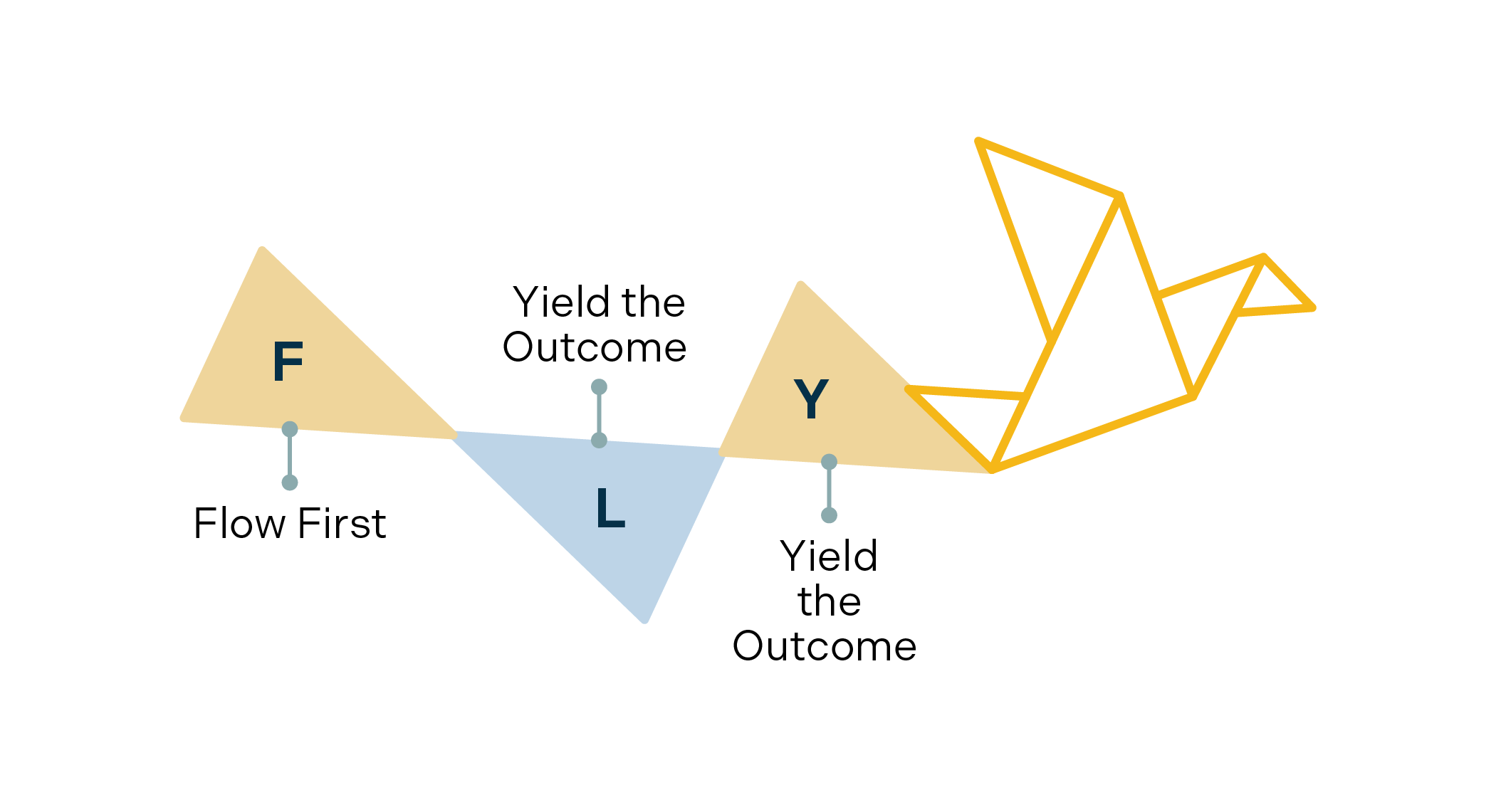
The Framework: The FLY Model (Flow–Lines–Yield)
To keep design grounded in execution, use FLY—a lightweight model that turns “structure” into a measurable delivery system.
F — Flow First
Before sketching a single rectangle, map how value actually moves:
from insight to prioritisation
from backlog to deployment
from issue to resolution
from request to approval to payment
from customer complaint to closure
Ask the questions that reveal truth:
Where is the work queue?
Where do decisions boomerang?
Where do approvals multiply?
Where do handoffs create rework?
These are your seams. Seams—not functions—are where transformations fail. Design starts with choreography; the chart should reflect the dance, not invent it.
L — Lines with Authority
Once flow is visible, clarify decision rights at the altitude where information is freshest and feedback is fastest. High-performing designs optimize for decision velocity, not headcount optics.
Three artifacts make this real:
A one-page decision map Who decides, who advises, who executes, who is informed. This removes “voice without vote” confusion—the most common trigger of meeting sprawl.
Guardrails (not escalations) Thresholds for spend, risk, and exceptions so decisions don’t travel upward by habit. Example: “Managers decide up to X; anything above escalates.” If thresholds don’t exist, every decision becomes political.
Cross-functional triangles Small business–tech–ops units empowered to commit resources within boundaries. These are not committees. They are decision-capable teams, designed to move work end-to-end without handoff bargaining.
Authority pushed down without clarity creates chaos. Clarity without authority creates theatre. You need both.
Y — Yield the Outcome (and Retire the Drag)
Org design must increase yield: fewer rework loops, fewer escalations, faster cycle time. That requires subtracting the drag that silently strangles execution:
duplicate reports that exist “just in case”
standing committees without a decision mandate
approvals that don’t protect value anymore
weekly meetings that exist to “align,” not decide
If governance exists everywhere, it protects nothing well. Good governance is thin, precise, and repeatable.
What “Good” Looks Like
When an organisation shifts from origami to execution, you’ll see it in behaviour—not in charts:
From “prove it to me” → “ship it together.” Work moves in cross-functional units with authority and boundaries.
From “alignment meetings” → “decision forums.” Meetings end with a verdict, not a follow-up.
From “shadow escalation” → “explicit guardrails.” People stop negotiating authority in corridors because the rules are clear.
A useful signal: the number of decisions that return in new decks (“decision recycling”) drops sharply.
How to Execute: A 30-Day Refold
If you want this to land like an operating rhythm—not a slide exercise—run org design as a sprint:
Week 1: Pick one critical flow Choose a high-friction value stream: customer onboarding, procurement-to-pay, product release, hiring, claims, collections.
Week 2: Map the seams Find the queues, boomerangs, and handoff delays. Name owners for each seam.
Week 3: Install authority Create a one-page decision map for that flow. Add thresholds. Define escalation routes.
Week 4: Prototype under load Run a “day-in-the-life” simulation using real work: a customer escalation, a regulatory request, an urgent supplier failure, a critical system outage. If the structure chokes, fix the seam—not the slide.
This approach avoids the classic failure mode: launching a new org chart and discovering its weaknesses only after reputational damage.
Risks and Trade-offs
New chart, old habits. Teams keep escalating because delegation isn’t trusted. Mitigation: hardwire thresholds into Delegation of Authority and reinforce through decision logs.
Committee sprawl. New councils appear for every cross-functional issue. Mitigation: sunset clauses—forums expire after 6 months unless renewed based on throughput.
Local optimization. One function improves but pushes delays downstream. Mitigation: measure end-to-end flow metrics (cycle time, time-to-market), not only functional KPIs.
Leadership Questions
Where do we lose the most time—inside functions, or at seams?
Which decisions still escalate by default because rights aren’t explicit?
If we removed 20% of approvals, what would actually break—and what would accelerate?
Do our forums produce closure—or recycle the same issues in new decks?


.svg)